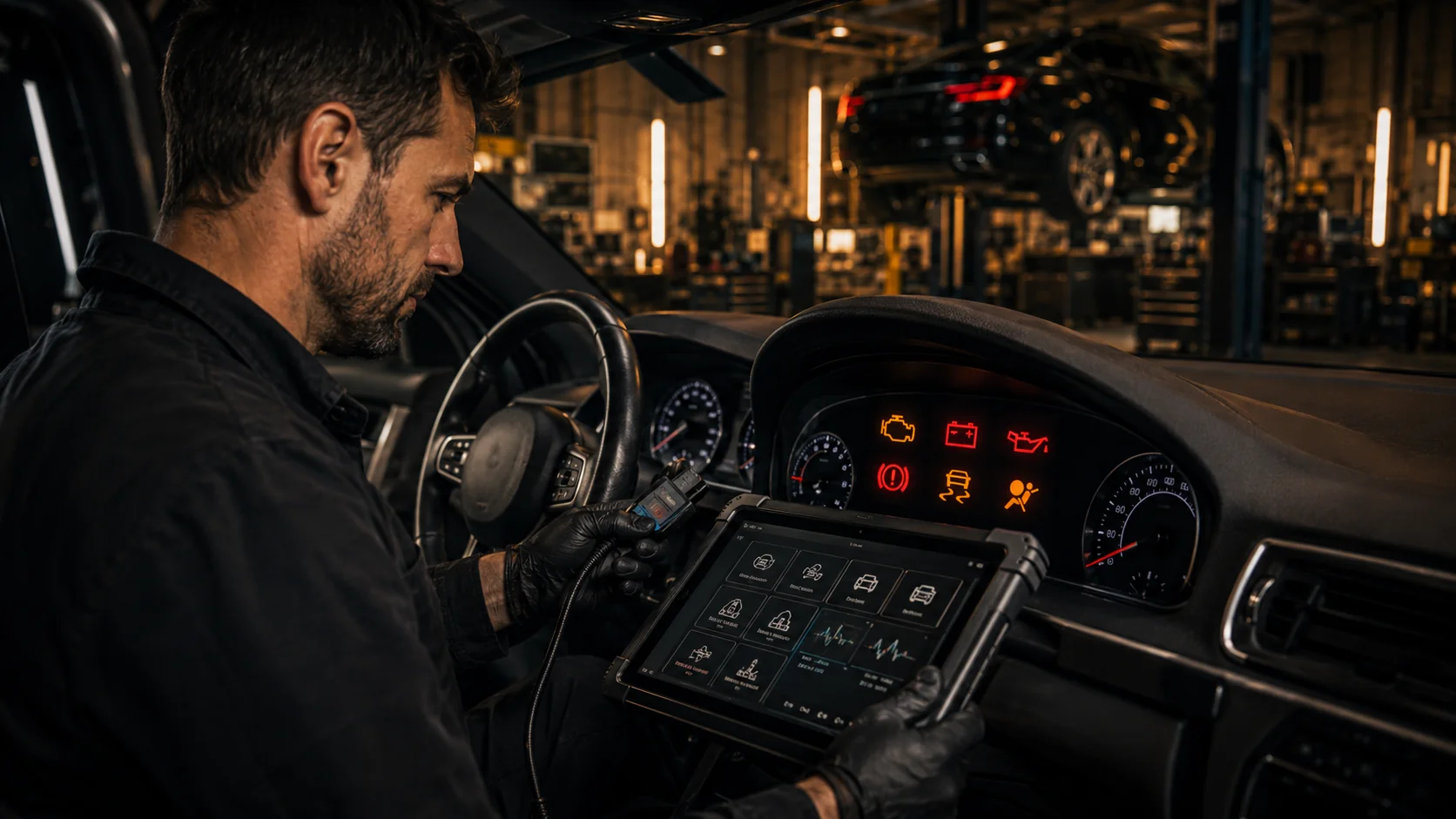





The warning lights on your dashboard are the language your car uses to talk to you. The easiest way to read them is by colour: red means "stop and check now", yellow or orange means "a fault — plan a workshop visit within the next few days", and green or blue simply tells you a given function is switched on. Below we explain the most important symbols, tell you which ones you can ignore and which you absolutely cannot, and show you when you genuinely need a diagnostic check.
Three colours, three levels of urgency
Manufacturers worldwide use the same traffic-light logic, so a warning light's colour instantly tells you how much of a hurry you should be in.
- Red — a serious problem or a safety hazard. Stop in a safe place, switch off the engine and check what's happening. Driving on could end in an expensive breakdown.
- Yellow / orange — a fault or a warning. The car usually still drives, but something needs checking. Book a diagnostic within a few days, not "some time next month".
- Green / blue — information. Lights, cruise control, driving mode. Nothing bad is happening.
This is the first thing we teach our clients: don't panic at every symbol, but never ignore a red one.
Red warning lights — stop and don't drive on
Red symbols are the ones where you risk your engine's health or your safety. Some of them demand an immediate response.
Oil pressure (red oil can)
This is the most dangerous warning light in the whole car. If it comes on while driving, it means a drop in oil pressure — and an engine without lubrication can seize within tens of seconds. Pull over, switch off the engine immediately and check the oil level with the dipstick. If the level is fine but the light won't go out, don't restart the engine — call for roadside assistance instead. Repairing an oil pump is cheap compared with rebuilding a seized engine.
Engine temperature (red thermometer)
The engine is overheating. The most common causes are low coolant, a faulty thermostat, fan or water pump. Stop, switch off the engine and wait for it to cool down — never open the radiator cap while hot, as it risks scalding. Driving with an overheated engine is a straight road to a blown head gasket, one of the more expensive repairs.
Battery charging (red battery)
The charging system has stopped working — usually the alternator, the accessory belt or the battery itself. The car will run for a while on stored charge, but once that runs out, the engine will die and won't restart. If the light comes on while driving, cut electrical consumption (air conditioning, heating, radio) and head straight to the workshop.
Braking system (red exclamation mark or the word BRAKE)
It may mean the handbrake is engaged — check that first. If the brake is released and the light stays on, the brake fluid level has probably dropped or the pads are worn. Brakes are no place for compromise — drive carefully and get them checked right away.
Airbags (SRS / airbag)
An illuminated airbag light means the airbag system is disabled and may not deploy in a crash. The car drives normally, but occupant protection is switched off. That's a clear-cut reason for a diagnostic check.
Red warning light = immediate response
With a red symbol, stop in a safe place and switch off the engine. Driving on — especially with oil pressure or temperature — risks a seized engine and a repair running into thousands of złoty.
Yellow and orange warning lights — check within the next few days
Yellow symbols rarely immobilise the car straight away, but ignored, they can turn a trifle into a serious repair.
Check engine (engine light)
The best-known and most often misread warning light. The orange engine outline means the control unit has detected a fault in the powertrain — from trivial (a loose fuel filler cap, a sensor) to serious (a misfire, a catalytic converter problem). The symbol alone doesn't tell you what happened — only a diagnostic computer can read the specific fault code. If the check engine light is flashing rather than steady, slow down and drive to the workshop — flashing usually means a misfire, which destroys the catalytic converter. Read more about how diagnostics pinpoint the cause in our article on the questions worth asking before a repair.
DPF / FAP (diesel particulate filter)
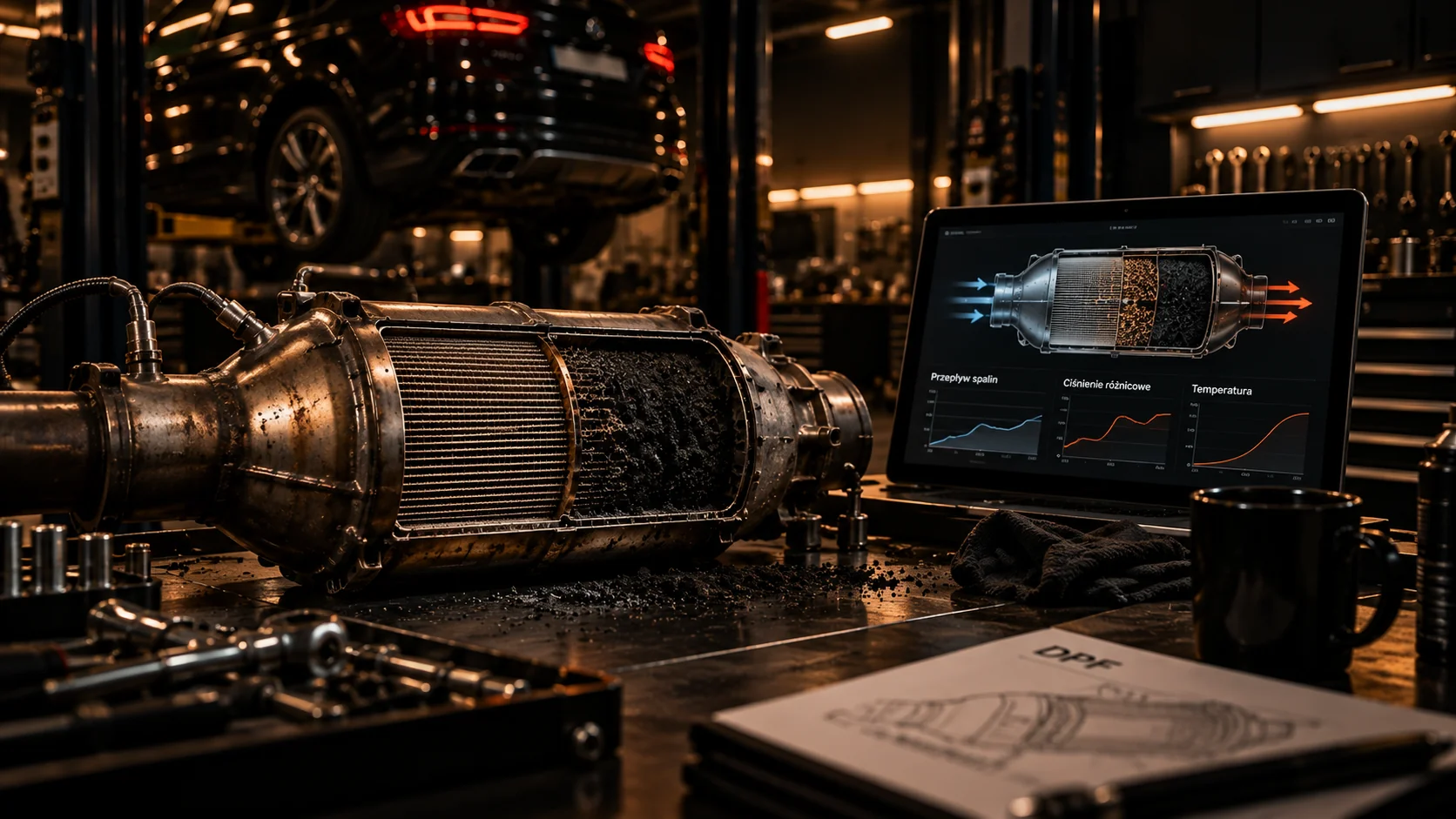
In diesels, this light means the particulate filter has filled up and needs burning off. Often a longer drive at a steady speed is enough to trigger regeneration. But if you mostly drive around town over short distances, the filter won't have time to clean itself and the light will keep coming back. Then it needs cleaning or regeneration — we covered this in detail in our piece on DPF cleaning vs replacement.
ABS
An illuminated ABS light means the anti-lock braking system is disabled. The brakes work normally, but under hard braking the wheels can lock up. The most common cause is a faulty wheel speed sensor — an inexpensive part worth replacing without delay.
ESP / traction control
If it stays on permanently (rather than flashing while driving on a slippery surface), the stability control system is disabled. The car handles normally in good conditions but loses support in a skid. It's worth finding the cause, especially before winter.
Tyre pressure (TPMS)
A yellow tyre cross-section symbol with an exclamation mark means the pressure is too low in at least one wheel. Check the pressures and inflate to the value on the plate on the driver's door pillar. If the light returns after inflating, you probably have a slow puncture or a faulty sensor.
Glow plugs (coil — diesels only)
During a cold start this symbol is normal and goes out after a moment. If it flashes or stays lit while driving, it means a problem with the glow plug system or a diesel engine fault — a signal to get a diagnostic.
Green and blue — information only
Green and blue symbols mean nothing is wrong. Green indicator lights, green cruise control, the green dipped-beam symbol — these confirm a function is active. The blue high-beam symbol tells you your full beams are on. There's nothing here to worry about.
Book a visit
If a warning light you can't decode has come on, don't guess. At the Brutalny Podnośnik workshop at Grabiszyńska 241 in Wrocław we'll connect a diagnostic computer, read the specific fault code and tell you whether it's a trifle or a serious matter — before it turns into an expensive breakdown.
What to do when a warning light comes on — step by step
Instead of panicking, run through a simple checklist:
- Check the colour. Red = stop now. Yellow = plan a visit. Green/blue = drive on calmly.
- Look at the symptoms. Is the car losing power, smoking, smelling strange, making knocking noises? These are important clues for the mechanic.
- Look in the manual. Every manufacturer describes the symbols in the service booklet — there can be small differences.
- Don't clear the fault "by force". Disconnecting the battery will kill the light, but the fault will return and you'll lose the diagnostic information.
- Book a diagnostic. Only a computer read-out will reveal the real cause.
Why the symbol alone isn't enough — the role of computer diagnostics
A warning light is a signal, not a diagnosis. The same orange check engine light can mean a loose fuel cap or a dying catalytic converter worth several thousand złoty. That's why the second step — always — is reading the control units' memory. We connect a diagnostic interface, read the fault codes, check live parameters (temperatures, pressures, fuel trims) and only then make a diagnosis. That's the difference between "let's swap parts one by one until it goes out" and "we know exactly what to fix". At our mechanical service in Wrocław, diagnostics is the starting point of every repair — so you don't pay for parts that weren't the cause of the problem.
Can I keep driving when the orange check engine light is on?
Usually yes — if the car runs smoothly, doesn't lose power and doesn't smoke, you can carefully drive to the workshop. But if the light is flashing, slow down and head straight for a diagnostic — flashing means a misfire, which quickly destroys the catalytic converter.
What should I do when a red warning light comes on while driving?
Stop in a safe place and switch off the engine. Red means a serious problem — most often oil pressure, temperature or charging. Driving on risks an expensive breakdown, and with oil pressure, even a seized engine within tens of seconds.
Why does the light go out and then come back on?
This is typical of intermittent faults — a loose sensor, tyre pressure fluctuations or a cyclical DPF regeneration, for example. The flickering doesn't mean the problem has gone away. The diagnostic computer logs such events in its memory, so a read-out will reveal the cause even when the light happens to be off.
Will disconnecting the battery reset the light?
Physically yes — but it's like switching off the alarm without putting out the fire. The fault remains, the light will return after a few driving cycles, and in the process you wipe valuable diagnostic data and control-unit adaptations. It's better to read the fault code and fix the cause.
How much does reading a warning light on the diagnostic cost?
Reading the fault codes alone costs a few dozen złoty and is often included in the price of the repair. It's the cheapest stage of the whole process — and the most important, because without it a repair rests on guesswork. Book a diagnostic at Brutalny Podnośnik, Grabiszyńska 241, and we'll tell you exactly what your warning light means.

A warning light you don't understand?
A warning light you don't understand?