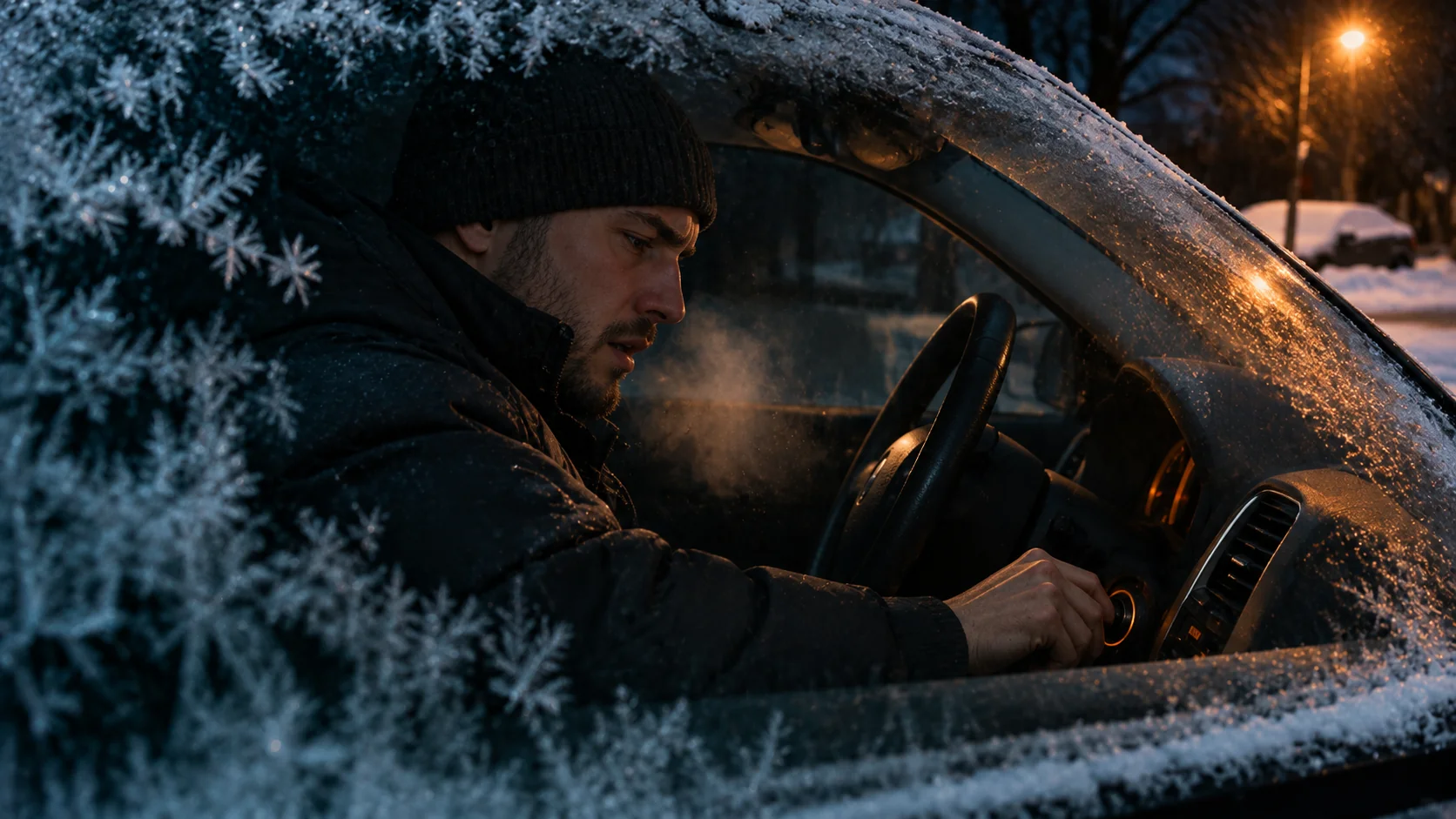






When your car won't start in freezing weather, switch off every electrical load, try starting the engine two or three times at most and listen to the starter. A rapid clatter or slow, laboured cranking points to the battery, and jump leads usually help here. If the starter cranks normally but the engine does not catch, look for the cause in the fuel or ignition, and on a diesel also in the glow plugs and thickened fuel. Below we go through it in the order that makes sense in the car park, before you call for help.
Where do you start when the engine won't fire?
In freezing weather every failed attempt takes away part of the battery's already modest reserve. So before you crank again, get the car ready to start.
- Switch off the lights, blower, heated screen, heated seats and radio.
- In a manual car press the clutch; in an automatic check that the lever is in P.
- Turn the ignition on and wait a few seconds so the pump can build fuel pressure and, on a diesel, the glow plug light can go out.
- Crank the starter for roughly 10 seconds at most.
- Leave about a minute between attempts. After the third failed attempt, stop and move on to diagnosis.
What does the sound tell you when you try to start?
Sound is the best free diagnostic you have to hand. Watch the dashboard as you try: whether the warning lights dim says a lot about the battery.
- Silence and a dark or fading dashboard — the battery is deeply discharged or a terminal has lost contact.
- A rapid clatter — there is enough current to engage the starter solenoid but not enough to turn the engine. It is almost always the battery.
- Slow, laboured cranking — a weak battery is fighting thick, cold oil. The car may still start, but each further attempt will be worse.
- One loud click with a brightly lit dashboard — there is current, so the starter motor becomes the suspect. Jump leads usually will not help here.
- Normal cranking but no start — the battery is coping, so look further: fuel, ignition, glow plugs, immobiliser.
- Starts and stalls moments later — on a diesel this is a common sign of a fuel supply problem; on any car it can also be the immobiliser.
In cars with a start button the culprit can also be a weak key fob battery, because the cold reduces its output too. The owner's manual shows where to hold the fob so the engine will start anyway. If something unusual is lit on the dashboard, look the symbol up in our guide to dashboard warning lights.
How does cold starting differ between petrol and diesel?
A petrol engine ignites the mixture with a spark, so in the cold its main trouble is that fuel vaporises less readily. A diesel has no spark: the fuel must ignite from the heat of compressed air, and a cold block takes that heat away quickly. Hence the different things to check.
Petrol: what to check when the starter cranks?
After several failed attempts the spark plugs can get flooded with fuel. On many cars, holding the accelerator fully down while cranking reduces injection and lets the cylinders clear, but check in the manual whether your model works this way. Worn spark plugs and coils also show up sooner in the cold. A car with an LPG system usually starts on petrol, so check there is enough in the tank.
Diesel: how do you spot a glow plug problem?
Glow plugs heat the combustion chamber before starting. Turn the ignition on, wait for the coil-shaped light to go out and only then crank. In hard frost you can repeat the cycle: ignition off, on again and wait once more. Signs of faulty glow plugs are long cranking, a shaking engine right after it fires and white smoke that clears as the engine warms up. If the coil light flashes after starting, that is your cue to come in for diagnostics.
The replacement itself can be harder than it looks, because a plug can seize in the cylinder head and snap if forced. The cost depends on the engine, so we agree the price after diagnosis.
Can diesel fuel freeze in the tank?
Strictly speaking it does not freeze, but at low temperatures paraffin crystals form in it. They block the fuel filter and the engine is starved of fuel. This most often affects fuel bought in autumn, which copes with frost less well than winter diesel. The symptoms are normal cranking with no start, stalling right after starting, or loss of power after a few kilometres.
There is little you can do about it in the car park. What works is warming the car, which means leaving it for several hours somewhere warm until the paraffin dissolves. A fuel additive prevents paraffin from forming, so it goes in before the frost. Once the filter is blocked, the additive alone is usually not enough and the filter often has to be replaced. In future, fill up with winter diesel at busy stations with high fuel turnover.
How do you jump start a car safely?
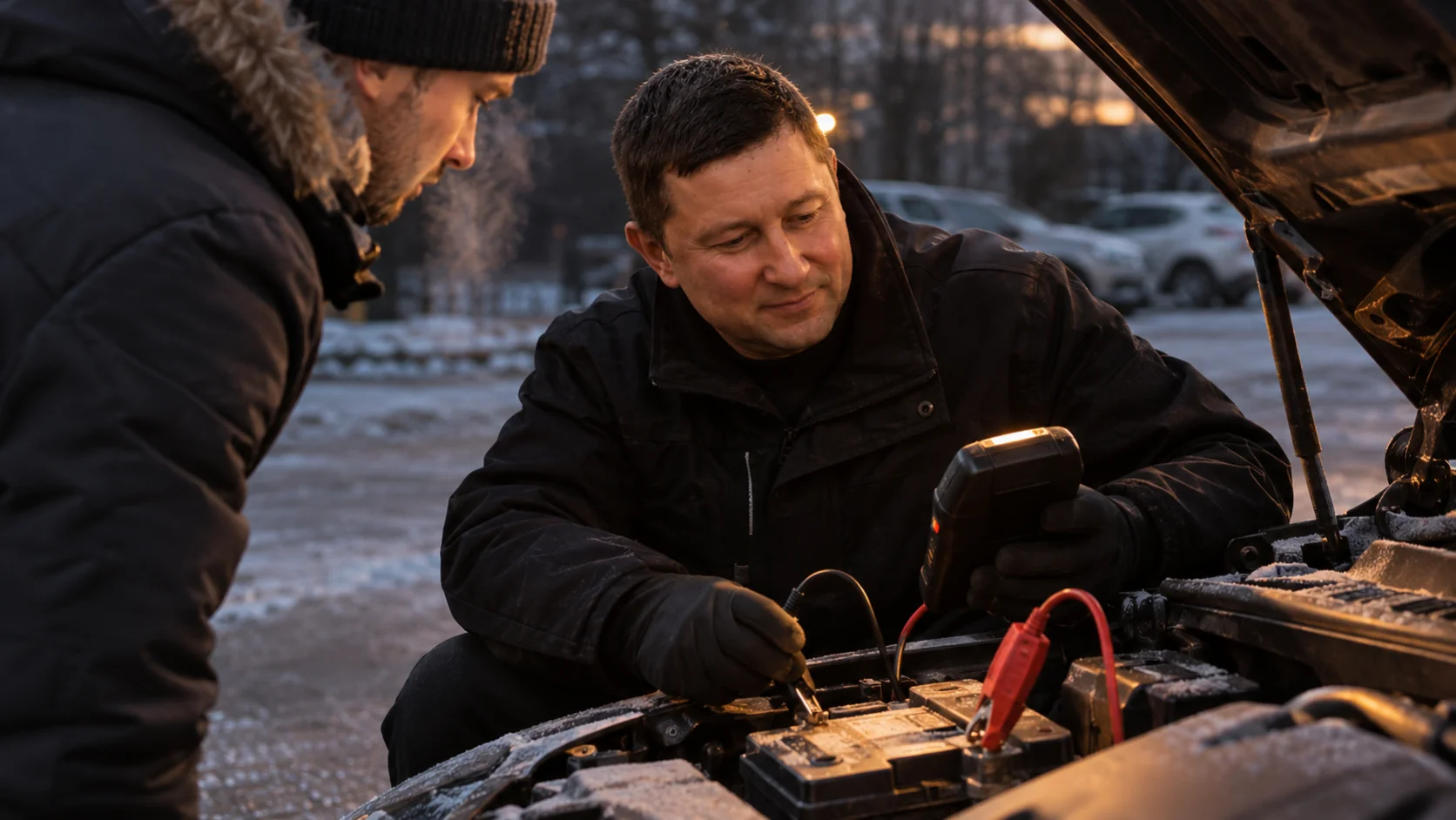
Jump leads make sense when the symptoms point to the battery. Both cars must have a 12 V system, must not touch each other and must be switched off before connecting. Check the manual first: some cars have dedicated jump start points, and hybrids and electric cars often cannot be used as the donor.
- Connect the red lead to the positive terminal of the flat battery.
- Connect the other end of the red lead to the positive terminal of the donor car's battery.
- Connect the black lead to the negative terminal of the donor battery.
- Connect the other end of the black lead to bare metal on the engine or body of the car with the flat battery, away from the battery.
- Start the donor car, wait a few minutes and then try starting the other car.
- Once it starts, disconnect the leads in reverse order, making sure the clamps do not touch each other or fall into the belt or fan.
Do not jump a frozen battery
If the battery case is bulging or cracked, or it gives off a sharp smell, do not connect jump leads or a charger. A battery in this state can explode. Leave the car and call for help.
What should you avoid when the car won't start?
- Do not crank endlessly. You will overheat the starter and finish off the battery.
- Do not use starting spray on a diesel with glow plugs, as it can damage the engine.
- Do not add petrol to diesel. Modern injection systems are sensitive to it.
- Do not heat the battery, filter or fuel lines with an open flame.
- Do not push start or tow start the car. In an automatic it is usually impossible, and in a manual it risks damaging the catalytic converter or timing drive.
- Do not leave the engine running in a closed garage, even briefly.
When should you call a tow truck instead of trying again?
After three attempts and one try with jump leads, further efforts tend to do more harm than good. Call roadside assistance when:
- jump leads did not help or you hear only a single click
- you suspect thickened fuel and have nowhere warm to put the car
- you smell fuel or burning, or can see a leak
- the battery looks damaged
- the car is in a dangerous spot, such as the hard shoulder of a busy road
Our tow truck operates in Wrocław and the surrounding area around the clock and will take the car to the workshop or an address of your choice. What to prepare before calling and how to wait safely is covered in our guide on how to call roadside assistance in Wrocław. The price depends on distance and time of day, so we give you the figure over the phone.
What next, once the engine is running?
Do not switch off straight away, and do not leave the car idling in the car park. Pull away gently and drive for roughly half an hour, ideally outside heavy traffic. A short trip to work will not put back what the start took out of the battery, so the problem will return the next morning. Remember too that a successful jump start fixes nothing. It is worth finding out whether the battery is worn or the alternator is not charging it. We explain what that test involves and what else to check before the season in our article on how to get your car ready for winter.
If the problem keeps coming back, bring the car for diagnostics to our mechanical workshop at Grabiszyńska 241. Computer diagnostics cost roughly PLN 150–350, and you will see other indicative prices in our booking form. We quote the repair cost once the cause is established.
How many start attempts make sense in hard frost?
Roughly three, each up to about 10 seconds, with a minute's break. If the engine does not start, further attempts will only drain the battery.
Will the battery recharge by itself after a jump start?
Partly, if the alternator works and you take a longer drive. A deeply discharged battery is better topped up with a charger, and an old one should be tested, as it may no longer hold a charge.
At what temperature does a diesel start having fuel problems?
It depends on the fuel. Winter diesel from the pump is designed for roughly –20°C, but fuel bought in autumn can cause trouble in much milder frost.
Can an automatic car be towed if it won't start?
Many automatics and hybrids should not be towed on their wheels, and the rules are in the owner's manual. The safest option is a flatbed tow truck.

Is your car struggling to start again?
We will run diagnostics and tell you plainly whether the battery, starter or fuel system is to blame.