




Failing mechatronics usually show up suddenly and irregularly: a gearbox warning appears on the dash, the car goes into limp mode, loses some gears or refuses to move in D or R, and after a restart everything works normally for a while. A worn clutch deteriorates more slowly and gives itself away through slipping and judder when pulling away, while an oil problem most often gets worse when the gearbox is hot. These are only pointers. Certainty comes only from reading the faults stored in the control unit, so below we answer the questions that usually come up when a DSG starts behaving strangely.
What exactly is the mechatronics unit?
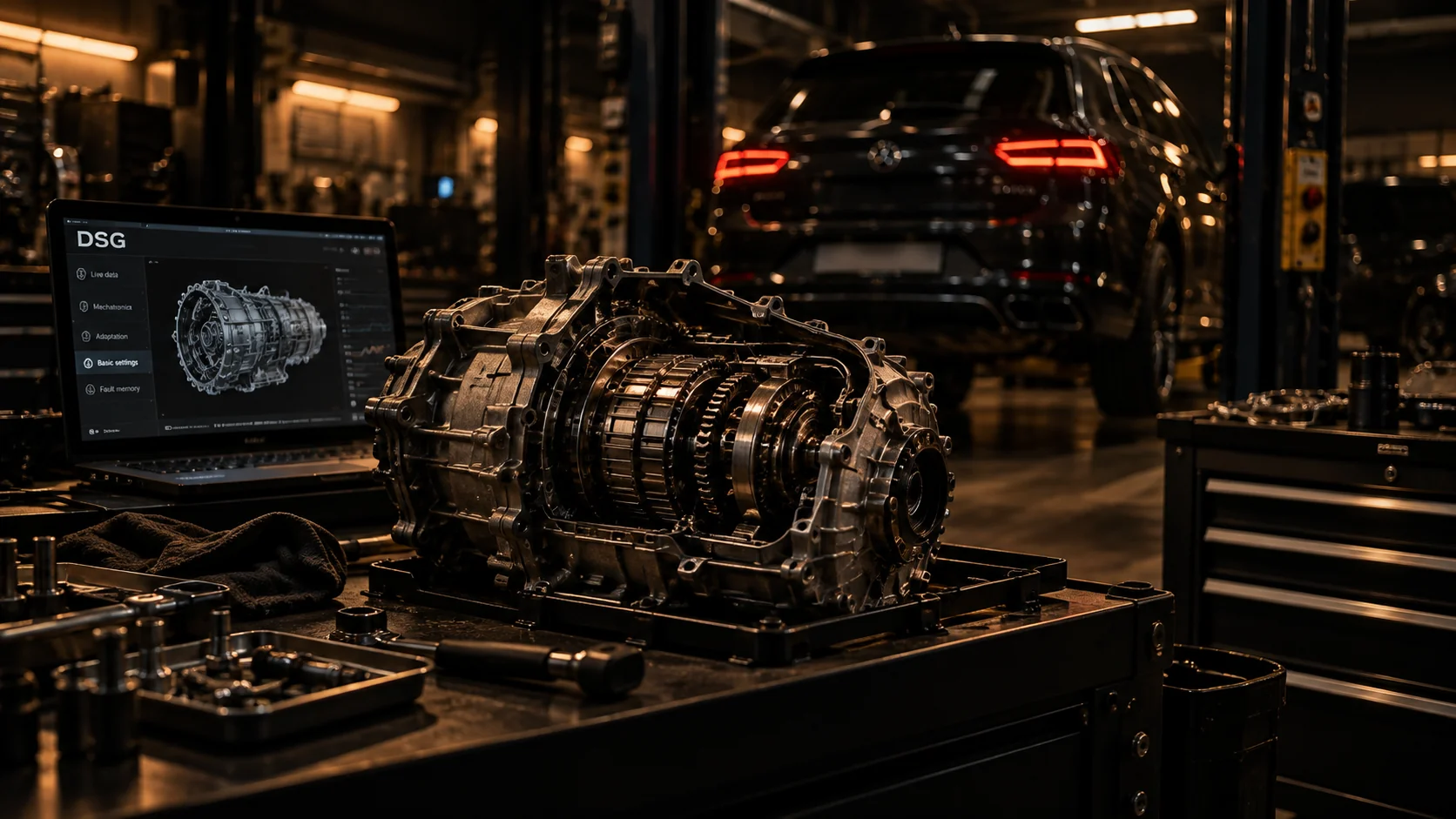
Workshops say “mechatronik” or “mechatronika” in Polish and mean the same thing: a module bolted to the gearbox that houses the control unit, sensors and hydraulic valves. It decides when to close which clutch and which gear to prepare. A DSG has no clutch pedal, so every gear change depends on oil pressure controlled by this single component.
That is why a fault can look very different from car to car. When a sensor fails, the gearbox loses information. When a valve works imprecisely, the clutch bites too hard or too late. When system pressure drops, the control unit switches off some functions to protect the gearbox. In each of these cases the driver feels the same thing: the automatic starts acting up.
Which symptoms most often point to the mechatronics?
- A gearbox message or flashing gear indicators — the fault appears suddenly, sometimes right after starting, sometimes halfway through a trip.
- Limp mode — the car stays in one gear, accelerates poorly and ignores a change of driving mode.
- Missing gears — the even or odd gears disappear, sometimes reverse as well, because the control unit shuts down one half of the gearbox.
- No response to D or R — the selector has moved, but the car stands still or pulls away after a clear delay.
- Hard knocks during gear changes — including when braking to a stop, regardless of the condition of the clutches.
- Symptoms that vanish after a restart — once the car is started again the gearbox returns to normal for a while, and then the problem comes back.
The last point is the most deceptive. If everything works after a restart it is easy to consider the matter closed, but the fault stays in the control unit's memory and its cause does not go away. Judder itself can also come from the mechatronics, but it has many other sources, which we covered in our article on why a DSG “kicks”.
How do I know it is not the clutch?
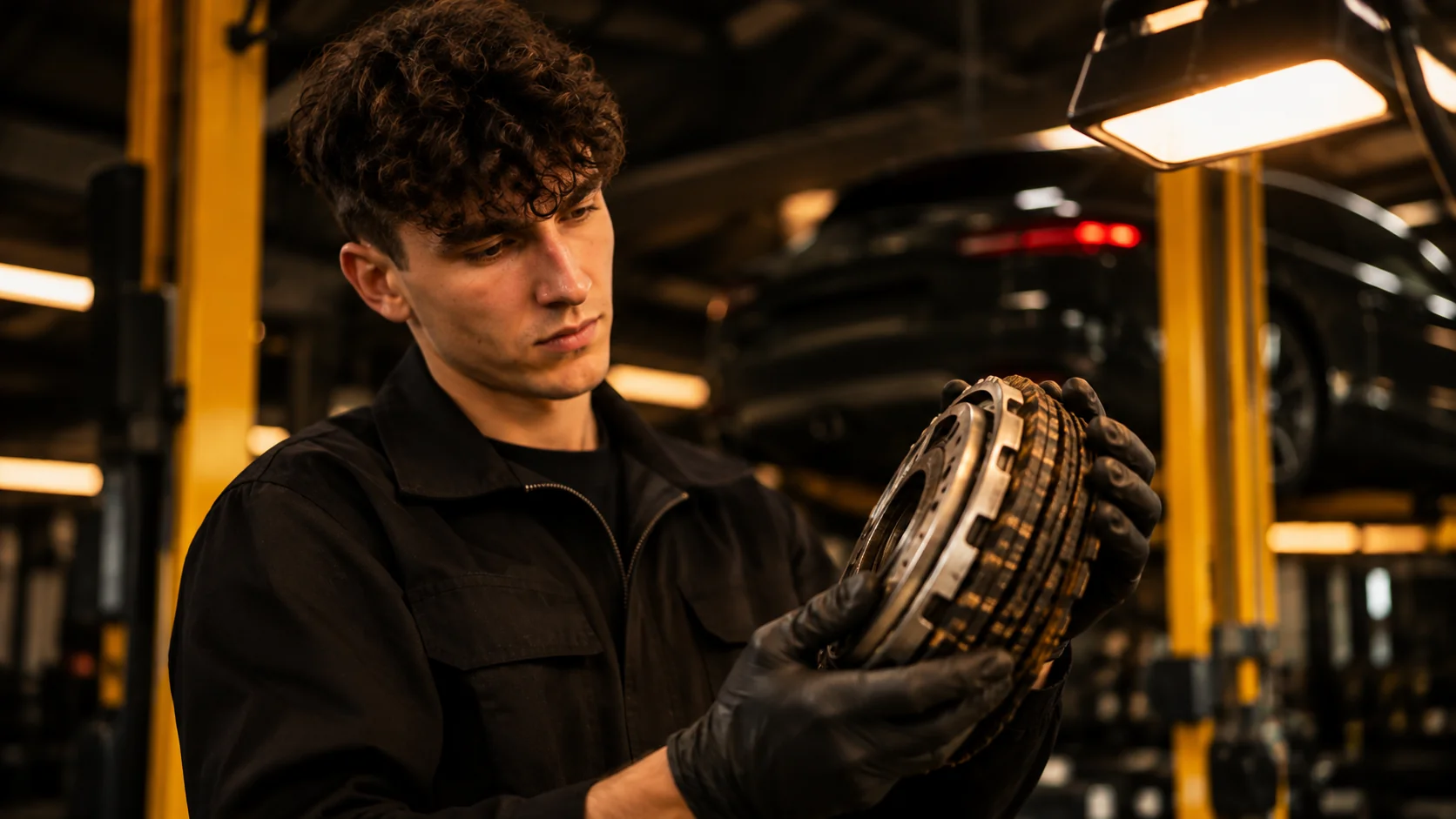
A clutch is a friction part, so it wears gradually. Things get worse over weeks or months rather than going wrong overnight. The typical picture is judder when pulling away and in traffic, revs rising faster than road speed and the smell of an overheated clutch after manoeuvring uphill. Mechatronics tend to be all or nothing: fine today, and tomorrow there is a warning and missing gears.
The line is not always sharp. A badly worn clutch can also trigger a warning light when the control unit runs out of adaptation range, and a faulty valve can cause judder similar to worn plates. Mileage alone settles nothing here. If you want to know what to expect from the plates, see our article on how long a DSG clutch lasts.
What if it is just the oil?
In wet-clutch gearboxes the oil cools the plates and also works in the hydraulic system. Symptoms linked to its condition usually get worse once the gearbox is hot, for example after a long crawl in traffic on a hot day, and ease as it cools down. Gear changes become less smooth, but all the gears remain available.
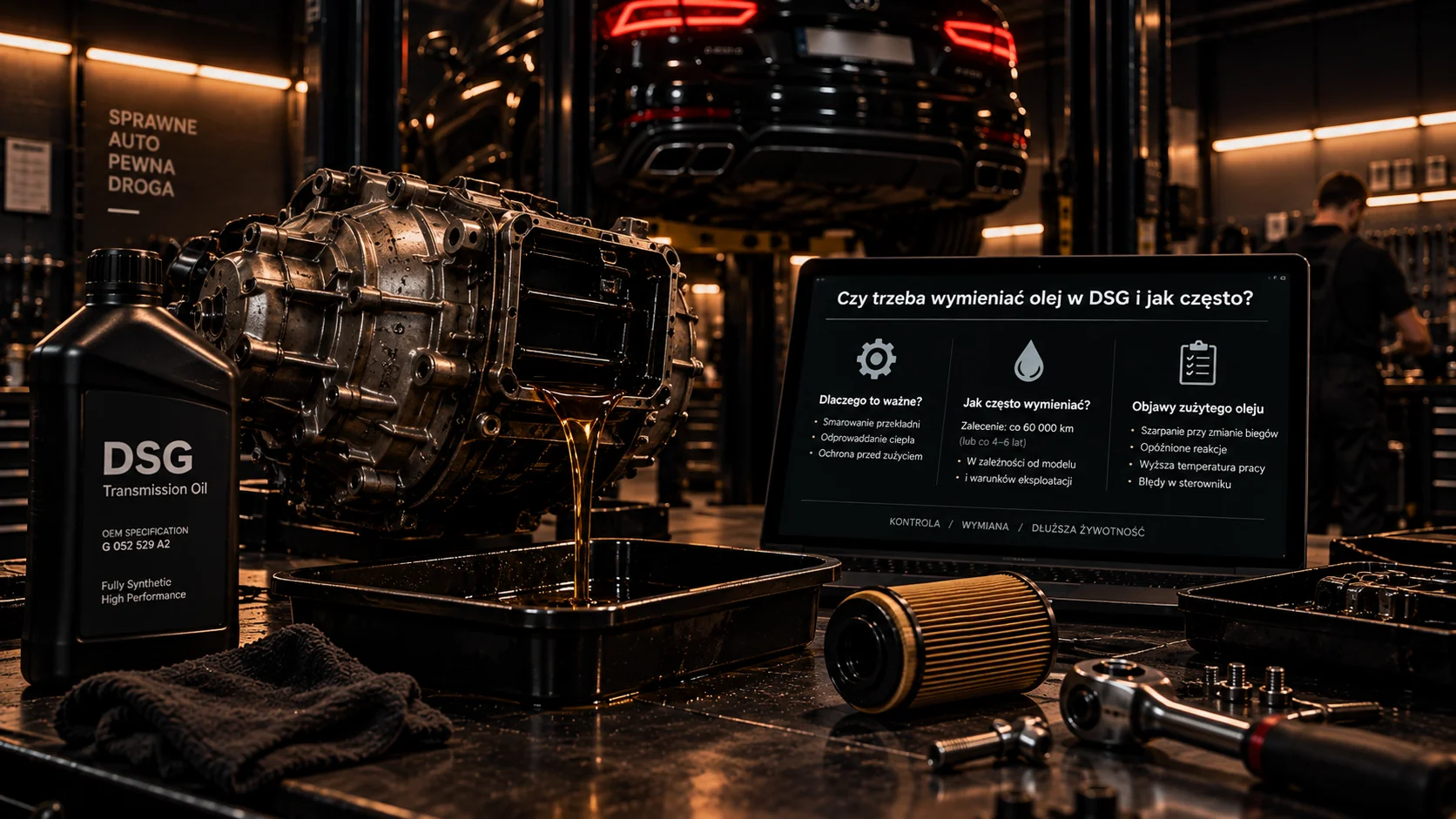
Oil and mechatronics are connected. Neglected oil can be the cause and the mechatronics the victim, because contaminants reach the narrow channels and valves. A change helps when the problem comes from the oil's condition, but it will not repair a damaged valve or electronics. We cover the intervals in our article on whether DSG oil needs changing.
How can you tell these three faults apart at a glance?
- Mechatronics — sudden onset, intermittent symptoms, a dash warning, limp mode, missing gears, temporary improvement after a restart.
- Clutch — slow deterioration, judder when pulling away, revs running ahead of road speed, a smell of overheating, a warning usually only at a late stage.
- Oil — symptoms grow with gearbox temperature and ease after cooling, no oil changes in the car's history, gears are available but work less smoothly.
This is only a first filter
Faults can occur together, and one can lead to another. This list helps you describe the problem to a mechanic, but it does not replace a control unit readout.
What else can mimic a mechatronics failure?
Before deciding on an expensive repair, cheaper causes need to be ruled out. A weak battery and voltage drops can cause random faults in various control units, including the gearbox one. A connector or wiring harness may be to blame. After the battery has been disconnected the gearbox can be temporarily uneven because it has lost its adaptations. Worn engine mounts and an unevenly running engine also cause jolts. So a warning on the dash is not yet a death sentence for the mechatronics.
Does it look the same in every DSG gearbox?
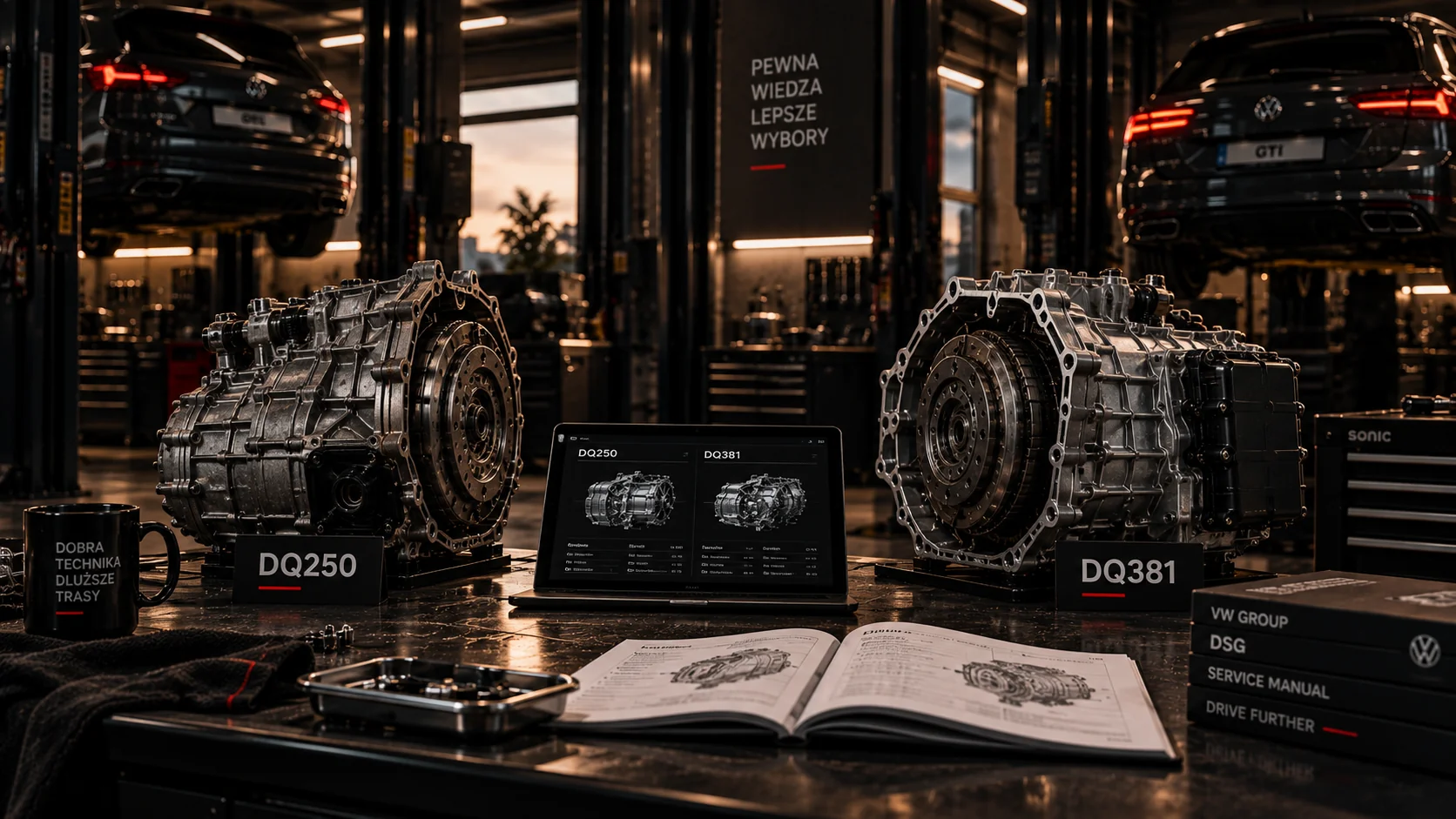
No. In the dry DQ200 the mechatronics have their own hydraulic oil circuit, separate from the gear set, and this pressure system is a known weak point. When it loses its seal, pressure drops and the gearbox can stop engaging gears from one day to the next. In wet gearboxes the oil's condition plays a bigger role, and valve and sensor faults are typical of the DQ250. We described the weak points of the wet designs in our comparison of the DQ250 and DQ381.
What should you do when these symptoms appear?
- Note the circumstances. When the fault occurred, whether the gearbox was cold or warm, at what speed and which gears were missing. A photo of the message helps too.
- Limit your driving. With occasional symptoms and no warning, book diagnostics within the next few days.
- Do not keep driving in limp mode. If the car will not move, loses gears or you hear grinding, it is safer to call roadside assistance.
- Do not clear the faults yourself. A deleted code is a lost clue, and disconnecting the battery also resets the adaptations.
- Do not replace parts on a hunch. A new clutch or fresh oil will not cure a valve fault, but the bill will remain.
We explain in more detail when you can still drive and when the car should stay parked in our article on whether you can drive with a juddering DSG.
A restart is not a repair
If the gearbox works after a restart, treat it as a chance to book diagnostics calmly, not as proof that there is no problem. Driving on with an unidentified fault can increase the scope of the repair.
How does a workshop confirm it is the mechatronics?
We start with computer diagnostics: we read the faults from the gearbox control unit and check its operating parameters. The result has to be compared with the symptoms and service history, because a fault code on its own often points to an area rather than a specific part. Computer diagnostics cost roughly PLN 150–350. You will see other indicative prices in our booking form.
Repair or replacement, and what does it cost?
That depends on what exactly has failed. Sometimes it is enough to deal with a sensor, wiring or the oil, and sometimes it means repairing, regenerating or replacing the module. We will not quote a price blind: the cost is agreed after diagnostics, because it depends on the gearbox type, the kind of fault and the parts. Be prepared for a major mechatronics repair to cost more than replacing the clutches.
After this kind of work the gearbox needs an adaptation, and before it is worth establishing what caused the fault, otherwise the problem may return. A used module from a breaker only looks like a shortcut: it has to match the specific gearbox, and its history remains unknown.
Can the risk of failure be reduced?
Nobody can give you certainty, but a few things help: regular gearbox oil servicing, a healthy battery, a quick reaction to the first symptoms and not raising engine power without adapting the gearbox. When buying a used car with a DSG, it is worth reading the gearbox control unit's faults before signing the contract, including those stored in memory but not currently active.
Can the mechatronics fail with no earlier warning signs?
Yes, sometimes the first sign is straight away a warning and limp mode. Often, though, there are earlier isolated knocks or brief hesitations from the gearbox that are easy to ignore.
Will a new clutch cure the symptoms of damaged mechatronics?
No. If a valve or sensor is working incorrectly, the new plates will be controlled just as badly. That is why the cause must be confirmed before ordering parts.
Can the mechatronics be repaired without replacing the whole gearbox?
Usually yes, because it is a separate gearbox module. The scope of the repair depends on the diagnostic result and the type of fault.
Can I drive to the workshop in limp mode?
It is better to avoid it. Limp mode protects the gearbox from greater damage, and forcing the car on can make things worse, so it is safer to transport it on a tow truck.

Let's check what is going on with your gearbox
We will read the DSG control unit faults and tell you plainly whether it is the mechatronics, the clutch or the oil.