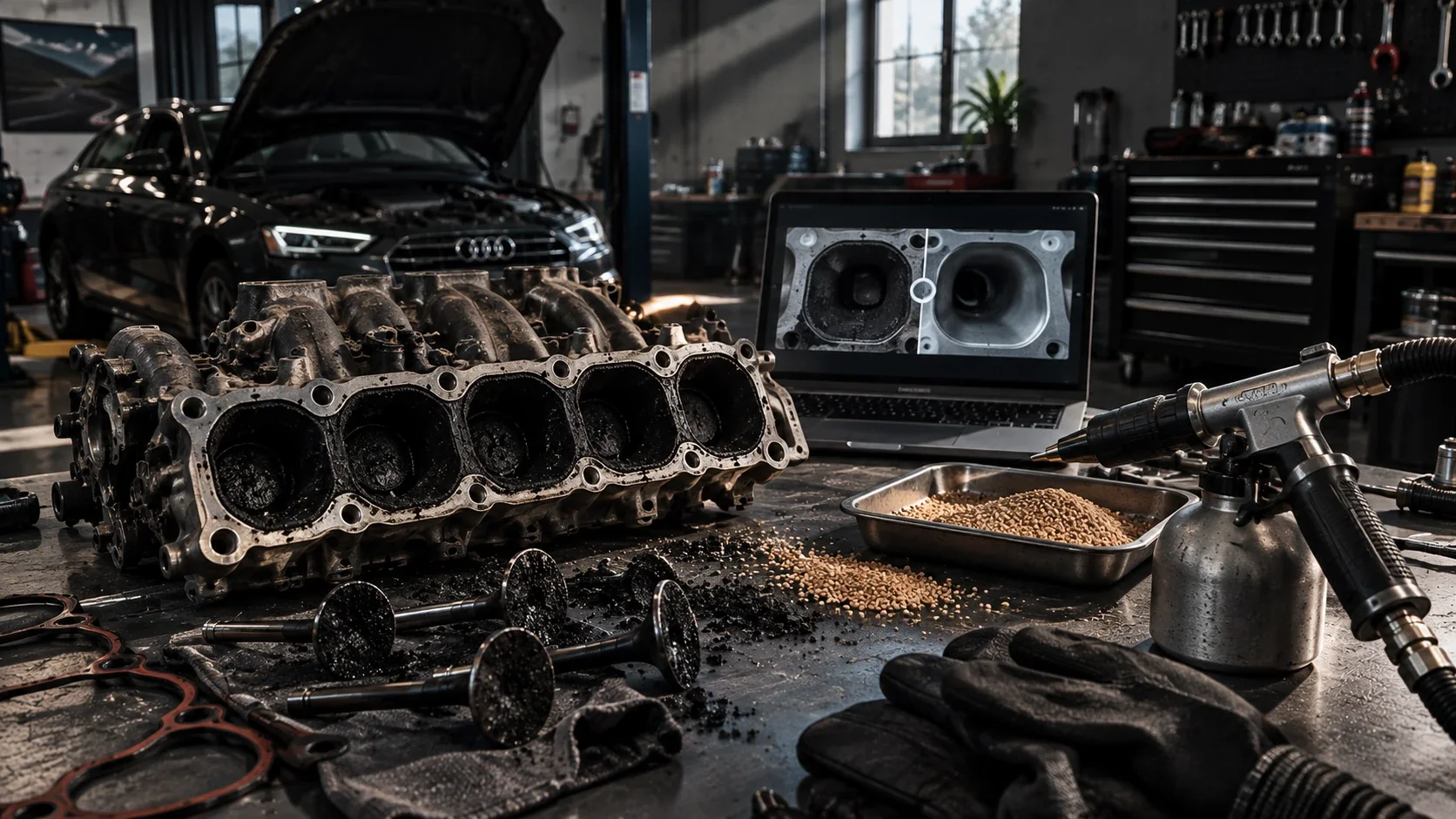









An Audi A4 B8 2.0 TFSI with 168,000 km came to us with symptoms its owner had been chasing for six months: juddering on a cold engine, noticeably weaker acceleration and fuel consumption up by more than a litre. His plugs and coils were new, the filters had been changed, and the computer showed nothing beyond an occasional misfire. Once we removed the intake manifold, the cause was visible to the naked eye — intake valves coated in a thick layer of carbon. Walnut shell blasting was all it took to bring the car back into shape.
What the customer arrived with
The symptoms the owner described:
- Juddering and rough running for the first 2–3 minutes after start-up
- A noticeable flat spot in acceleration at low revs
- City consumption rising from 9 l/100 km to around 10.5 l/100 km
- A check engine light coming on every few weeks
- Earlier replacement of plugs, coils and the air filter — with no improvement
This is a very typical story. The owner did exactly what most drivers do — he replaced the cheapest and most obvious parts. The trouble is that a carbonised intake has no fault code of its own. We covered how carbon builds up in our article Walnut blasting the intake — symptoms of carbon build-up and how it works.
The diagnosis — why OBD showed nothing
We started by reading live parameters rather than taking the car apart. Fuel trims were elevated and the spread between individual cylinders clearly deviated from the norm — most of all on cylinders 2 and 3. Compression was correct, so the engine was mechanically sound. That ruled out damaged valves or rings and pointed to restricted airflow.
Carbon has no fault code
The ECU only sees the effect — a poor mixture and misfires. It won't name the cause. That's why a carbonised intake so often ends in a string of part replacements that change nothing.
Final confirmation came from an endoscope inserted through the manifold opening: the intake ports and valve heads were covered in a hard, matte crust several millimetres thick. In a direct-injection engine nothing washes those valves, so after 150,000 km this sight is the rule rather than the exception.
How the job went
- Removing the intake manifold and protecting the engine bay
- Positioning the pistons so the valves in the cylinder being cleaned are closed
- Feeding walnut shell granulate under pressure, cylinder by cylinder, while extracting the carbon at the same time
- Endoscope check after every cylinder — we clean down to bare metal
- Cleaning the manifold itself and the throttle body, replacing the gaskets
- Reassembly, clearing the fault codes and a test drive
The whole job took one working day — the car was dropped off in the morning and collected in the afternoon. Walnut granulate is hard on carbon and soft on metal, so neither the valves nor the ports get scratched. We don't use aggressive chemicals poured into the intake for this: at best they soften the deposit, at worst they push it further into the cylinder.
The manifold has to come off anyway
Any "non-invasive" method promising to clean valves without removing the manifold simply doesn't reach where the carbon sits. If someone isn't taking the manifold off, they aren't cleaning your valves.
The result — before and after
After the job, the cold-engine juddering was gone completely from the very first start. Fuel trims returned to around zero, the cylinder spread evened out, and two weeks later the owner reported consumption back to what it was before the problem. What pleased him most, though, was the throttle response he got back between 1,500 and 2,500 rpm — exactly where restricted airflow hurts the most.
A fraction of a cylinder head rebuild
The alternative another shop had offered him was removing and reconditioning the cylinder head. Walnut blasting settled it in one day for several times less money.
What next, so the carbon doesn't come back
The carbon will build up again — that's simply how direct injection works. You can slow it down considerably though: change good-quality oil regularly and don't stretch the intervals, avoid a diet of nothing but short city trips, and keep the crankcase ventilation and EGR in good order. With this customer's driving style we've pencilled in the next clean at roughly 80,000–100,000 km.
How long does walnut blasting take?
Usually one working day. You drop the car off in the morning and collect it in the afternoon. The time depends on how easily the manifold comes off on your particular engine.
Can the granulate damage the engine?
No, not when the job is done properly. Walnut shell is soft on metal, and we extract the granulate as we go. The valves of the cylinder being cleaned are closed, so nothing reaches the combustion chamber.
How do I know it's the intake and not something else?
The typical set is juddering when cold, a flat spot at low revs and higher fuel consumption on a direct-injection engine past 100,000–150,000 km, with healthy plugs and coils. Only an endoscope gives certainty — and that's where we start.
Does anything need resetting after the clean?
We clear the stored fault codes and let the ECU relearn its fuel trims during the test drive. Nothing else is needed.
How often should the job be repeated?
Roughly every 80,000–100,000 km, but it depends heavily on driving style, oil and the state of the crankcase ventilation. On nothing but short city trips the carbon comes back sooner.
If your car behaves the same way and new plugs and coils changed nothing, start with a diagnosis instead of yet more parts. For more on telling apart the causes of rough running, see our article Why does my car stall and run rough at idle?. The details of the service itself are on our Walnut blasting page.

Is your TFSI juddering when cold and losing power?
We'll look inside the intake with an endoscope and tell you straight whether walnut blasting will actually help. Grabiszyńska 241, Wrocław.