






After suspension parts are replaced, wheel alignment is not an add-on — it is part of that repair. This case shows it particularly clearly: the customer came to us in a Passat B7 1.6 TDI with around 210,000 km on the clock, a week after having the control arms and drop links replaced. The car began pulling gently to the right, the steering wheel sat slightly turned when driving straight, and the outer shoulder of the front right tyre was already visibly worn. The measurement on the 3D HUNTER took a matter of minutes and immediately showed where the problem was. Below: the "before" printout, exactly what we adjusted and how the car behaved afterwards.
The starting point: what the customer reported
The complaint was classic for a suspension repair that was left unfinished. The parts had been fitted correctly, the knocking was gone, but the car started behaving differently than before the repair. The driver described three things: a slight but constant pull to the right on a flat road, a steering wheel that sat crooked, and a "rough" feel coming out of corners. After a control arm replacement, this is not a fault of the new parts — it is a sign that the factory suspension settings were never restored. We cover the symptoms of worn parts themselves in our article Symptoms of worn suspension.
Why replacing control arms always changes the alignment
A control arm, drop link or ball joint defines the position of the wheel relative to the body. Replacing such a part shifts the mounting points by fractions of a millimetre — and that is enough to push the toe outside the manufacturer's tolerance. That is why a wheel alignment check after any suspension work is a standard step, not an upsell.
The measurement before adjustment — what the HUNTER showed
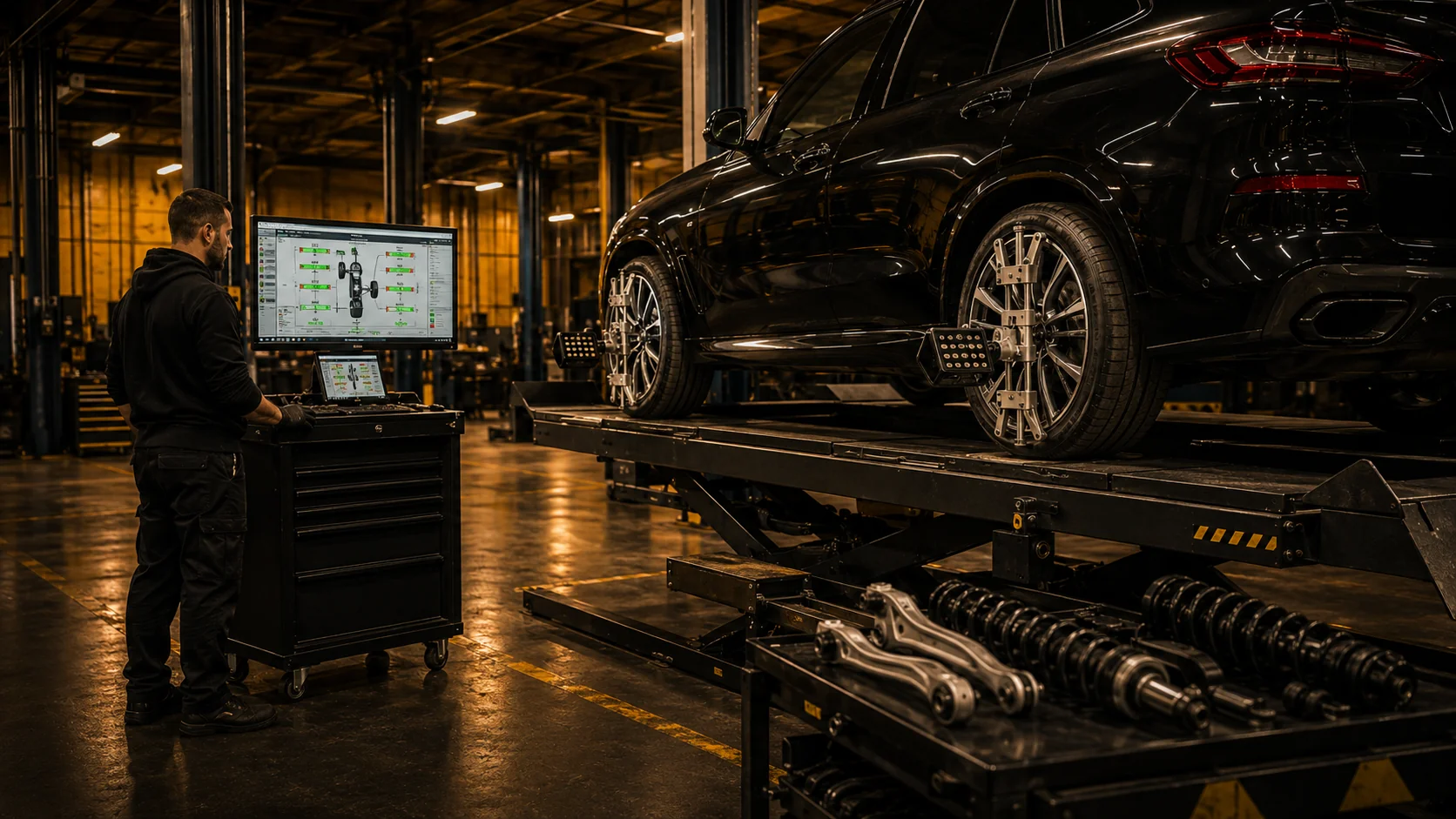
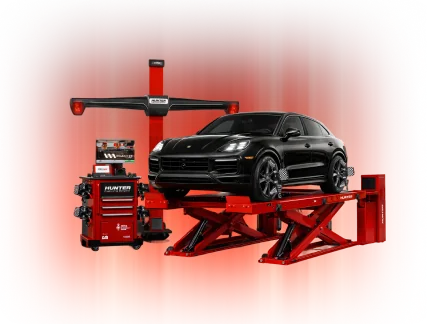
The car was driven onto the alignment rack, we fitted the heads on all four wheels and, after a quick runout compensation, we had the full set of values. The 3D system reads every parameter at once and compares it with the database for that specific model — there is no room here for setting things "by eye". The "before" printout looked like this:
- Total front toe — clearly outside the manufacturer's tolerance, weighted to the right-hand side. That was the main reason for the pull and for the wear on the outer shoulder of the right tyre.
- Individual toe of the front wheels — asymmetric, which explained the crooked steering wheel: the car was tracking straight, but the wheel rim sat rotated to the left.
- Camber — right-hand side at the edge of tolerance, left-hand side within it. A side-to-side difference is a classic source of pulling.
- Caster — within tolerance, with no sign of kerb or pothole damage.
- Thrust angle — correct, so the rear of the car was not steering it sideways; the problem was purely at the front.
That is an important diagnostic conclusion: since the caster and thrust angle were fine, we could rule out a bent rear beam or impact damage. What remained was what the recent repair had changed — the front axle settings after the control arms and drop links were replaced.
The adjustment — exactly what we set
The whole job on the rack took about an hour and ran in four steps:
- Preparing the car — checking tyre pressures, play in the track rods and the condition of the new parts. Adjusting on worn track rod ends makes no sense, because the settings will not hold for even a few hundred kilometres.
- Baseline measurement — the full set of values for both axles saved as the "before" state, for comparison and for the customer's printout.
- Setting the steering wheel and adjusting the toe — the steering wheel locked in the straight-ahead position and the toe set on the track rods symmetrically on both sides, until the values sit in the middle of the manufacturer's tolerance.
- Check measurement and printout — a repeat reading of every parameter and a printout with the before and after values, which the customer takes away.
Not every car adjusts the same way
On this Passat only the front toe was adjustable — and that was enough. On many cars the front camber is not adjustable from the factory and needs eccentric bolts or modification, while on the rear axle it is often the other way round: both toe and camber can be set. That is why we always define the scope of the adjustment after the measurement, never before it.
The result: before and after
- The pull to the right — gone. The car holds its line on a straight road with no steering correction.
- The steering wheel — sits straight, badge centred, no offset when driving straight ahead.
- Toe and camber — all values in the middle of the manufacturer's tolerance, symmetrical on both sides.
- Tyres — the wear has been stopped. The already worn shoulder of the front right tyre cannot be undone, but the rest of the tread will now wear evenly.
- Handling — after the test drive the car responds predictably and returns to centre by itself after a corner.
One hour instead of a set of tyres
Had the customer driven another few thousand kilometres on those settings, the front right tyre would have been due for replacement — and in practice he would have replaced the pair. An hour on the HUNTER rack costs a fraction of that, and that is the entire arithmetic of this service.
What this case teaches
New parts do not guarantee a car that handles well — only correct settings do. If, after replacing control arms, dampers, springs or track rods, someone tells you that "alignment isn't needed, the car drives straight", it is worth verifying that with a measurement: uneven tyre wear starts long before the driver feels any difference through the steering wheel. When else it pays to have the alignment measured, we described in Wheel alignment — when to do it, symptoms and prices in Wrocław.
- Have the alignment measured after every replacement of suspension or steering components.
- A crooked steering wheel when driving straight is not something to "get used to" — it is a specific individual toe error.
- Always ask for the before and after printout — then you have it in black and white what was changed.
- Alignment is done on sound suspension; if there is play, repair first, alignment second.
Is a wheel alignment necessary after replacing control arms?
Yes. The control arm sets the position of the wheel, so replacing it almost always changes the toe and often the camber as well. Without a measurement you are driving on random settings — and those can ruin a tyre within a few thousand kilometres.
How long does a HUNTER wheel alignment take?
A measurement with adjustment usually takes 45–60 minutes. In this case we also checked for play and took the car for a test drive, so it was with us for a little over an hour.
Will I get a printout with the results?
Yes, every customer receives a printout with the values before and after the adjustment. It is a document worth keeping — at your next visit it shows whether the settings have held.
The car pulls but the steering wheel is straight — is that also the alignment?
Not necessarily. Pulling without a crooked steering wheel can come from a difference in tyre pressures, unevenly worn tyres on the same axle or a seized brake caliper. The measurement verifies it: if the values are within tolerance, we look for the cause outside the alignment.
Do you align vans as well?
Yes — we work on passenger cars and vans of all makes, and the HUNTER database covers a wide range of models. Just select the vehicle type when you book.

Had your suspension replaced? Check the alignment
3D HUNTER measurement with a before and after printout — Wrocław, Grabiszyńska 241, usually 45–60 minutes. See also our HUNTER wheel alignment service.