

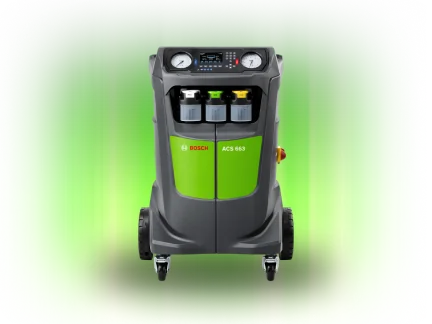





A full air conditioning service has six stages: recovering the old refrigerant and measuring how much was left, pulling a vacuum and checking for leaks, topping up the compressor oil, charging the system with exactly the amount of refrigerant the manufacturer specifies, disinfecting the evaporator and checking the outlet temperature. On a Bosch station the whole process usually takes 60–90 minutes. Just “topping up the gas” without recovery, vacuum and a leak test is not a service — it only postpones the problem, especially if the system is losing refrigerant somewhere.
Below we describe exactly what happens to your car at the A/C bay at Brutalny Podnośnik, Grabiszyńska 241 in Wrocław, why every stage matters and what to ask your workshop so you don’t pay for half a job. If you are mainly looking for prices, see our article on A/C recharge and service in Wrocław — prices.
How car air conditioning works — the minimum worth knowing
Car air conditioning is a closed loop in which refrigerant circulates together with a small amount of oil. The compressor compresses the gas and raises its temperature, in the condenser in front of the engine radiator the refrigerant gives off heat and turns into liquid, the receiver-drier traps moisture, and the expansion valve drops the pressure sharply. Only in the evaporator, hidden behind the dashboard, does the refrigerant evaporate and draw heat from the air going into the cabin.
This design has three consequences that matter for servicing. First, the system works properly only with a specific amount of refrigerant — both too little and too much reduce cooling. Second, the oil travels with the refrigerant, so when gas escapes, the compressor’s lubrication goes with it. Third, the evaporator is permanently damp and dark, which makes it an ideal home for mould and bacteria.
Before connecting the station — a quick talk and inspection
We start with a few questions: when the A/C was last serviced, whether cooling faded gradually or stopped suddenly, and whether there is a smell or noise when the compressor kicks in. A sudden loss of cooling more often points to an electrical or mechanical fault than to normal refrigerant loss — and in that case a recharge alone won’t help.
Next we read the refrigerant type and its quantity in grams from the label under the bonnet. Older cars, roughly up to 2017, use R134a; newer ones use R1234yf. These are two different gases with different service ports and different oils — they must never be mixed. We also inspect the condenser (is it clogged with leaves and insects, any impact damage?), the hoses and fittings, and check that the radiator fan switches on.
Step by step — what happens on the Bosch station
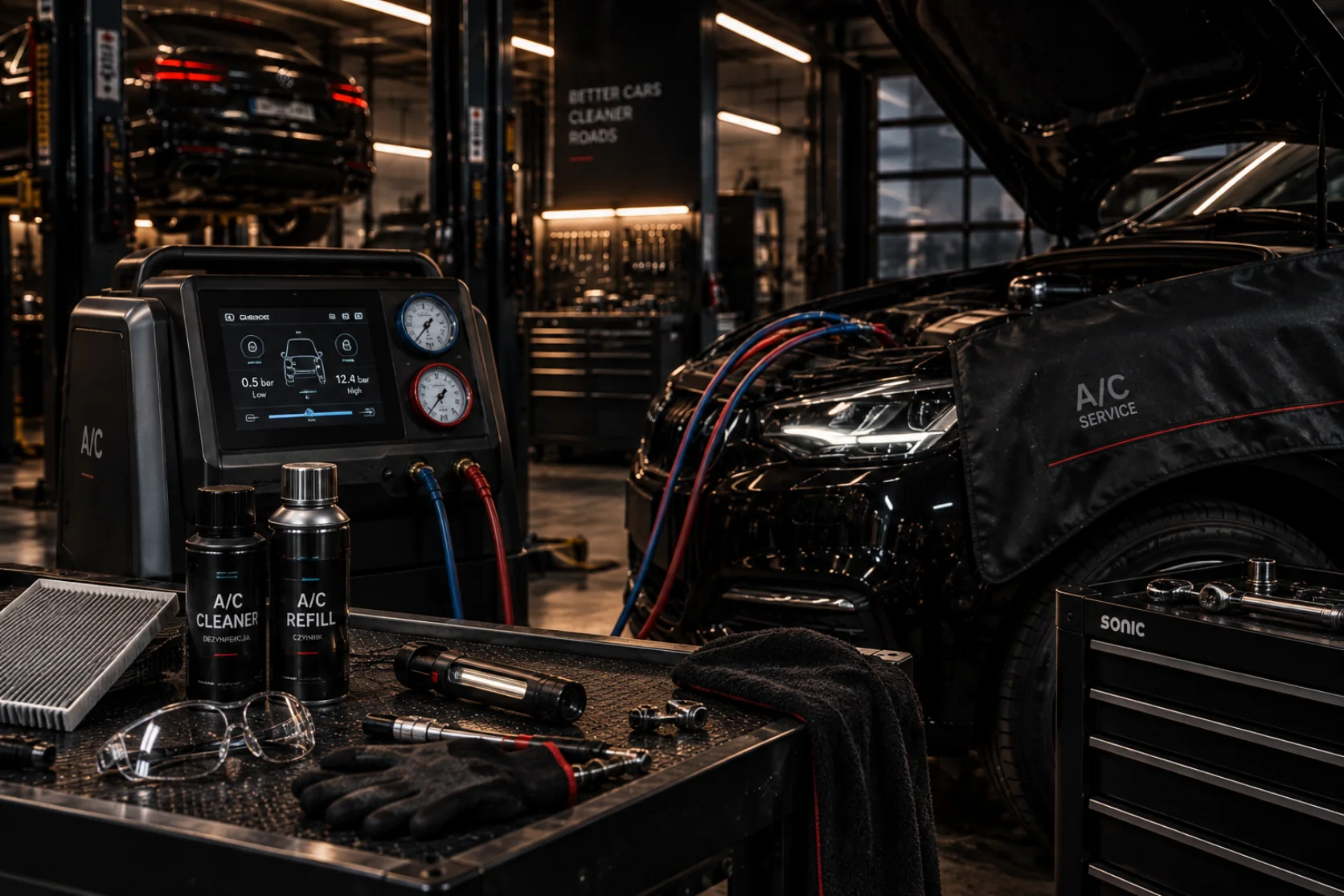
The service itself on an automatic station runs in six stages:
- Refrigerant recovery and measurement — the station extracts all the gas from the system, cleans it and weighs it. Comparing that with the label value is the first and very valuable piece of information: 90% of the charge after two years is normal; 40% means there is a leak somewhere.
- Oil recovery and measurement — some oil comes out with the refrigerant. The station measures it so that exactly the same amount of fresh oil can be put back.
- Vacuum and leak test — a pump pulls a deep vacuum in the system and holds it for several tens of minutes. The vacuum boils off moisture inside the system, and the station checks whether it holds. If it drops, the system leaks and we don’t charge it “blindly”.
- Oil and UV dye — we add fresh oil of the correct type (PAG for most cars, a special oil for electric compressors in hybrids and EVs) plus UV dye, which makes any future leak easier to find.
- Charging to the gram — the station injects exactly as much refrigerant as the manufacturer specifies. Charging “by the gauge” or “until it gets cold” is a sure way to overfill the system, which overloads the compressor.
- Performance test — we run the engine and A/C at maximum, measure the temperature at the centre vent and watch the low- and high-side pressures. Under typical conditions the air from the vent should be just a few degrees Celsius.
Why the vacuum takes so long
Moisture in the system combines with refrigerant and oil to form acids that slowly destroy the compressor and expansion valve. A short vacuum “for the record” doesn’t have time to remove it. That’s why a proper service doesn’t take 15 minutes, even if the station is automatic.
Leak tightness — the most important stage almost nobody mentions
Every A/C system naturally loses a little refrigerant through seals and porous rubber hoses — usually a few to over ten percent a year. That’s normal, and it’s exactly why the system should be serviced every 1–2 years. The trouble starts when the loss is large or the gas disappears within weeks of a recharge. Recharging such a system is throwing money away, and it makes the compressor run without proper lubrication.
How we find leaks
- Vacuum test — done at every service. It detects clear leaks but won’t show exactly where they are.
- UV lamp — if the system contains dye, after a few days of driving the leak glows under the lamp. Most often it’s hose fittings, the condenser and the compressor shaft seal.
- Nitrogen test — the system is filled with dry nitrogen under pressure and suspicious spots are checked by ear or with leak-detection foam. This is the method for small, hard-to-find leaks when there is no dye in the system yet.
- Electronic leak detector — a sensor that picks up trace amounts of refrigerant in the air, useful around the evaporator, which can’t be seen without taking the dashboard apart.
In practice the most common culprit is the condenser. It sits at the front of the car, takes stones from the road and winter salt, and its thin aluminium walls corrode over time. Second place goes to the O-rings on hose fittings, which harden over the years. Fortunately, both are relatively cheap to fix — unlike replacing a compressor ruined by running on a half-empty system.
A/C sealant “in a can” is a bad idea
Sealants poured into the A/C can clog the expansion valve, the receiver-drier and the service station’s filters. Many workshops then refuse to service such a system or charge extra for the risk of contaminating their equipment. A leak needs to be found and repaired, not glued shut.
Disinfection and the cabin filter — where the smell comes from
The “cooling” part of the service takes care of temperature; disinfection takes care of air quality. Water condenses on the evaporator, and mould and bacteria thrive in that dark, damp space — hence the musty smell when you switch on the fan. During the service we use either a treatment applied directly to the evaporator or ozone treatment of the whole cabin and air ducts; we compare the two methods in detail in our article A/C disinfection — ozone or Bosch.
Disinfection without replacing the cabin filter works for a few weeks at most. The old filter is full of dust, pollen and moisture, so it quickly becomes a source of odour again. An activated-carbon filter costs only a little more than a standard one and is much better at stopping smells and exhaust fumes in traffic on Grabiszyńska or Legnicka.
How to check the service was done properly
Customers rarely stand next to the station, but there are a few things you can check when you collect the car. A well-done service leaves a trail of specific numbers, not just “recharged, it’s cold”.
- Station printout — shows how much refrigerant was recovered, how much oil came out, how long the vacuum lasted and how many grams were charged. On a Bosch station this is standard.
- Information about the loss — the workshop should tell you what percentage of the charge was left in the system. That’s the basis for deciding whether to look for a leak.
- Vent temperature — after a few minutes at maximum, the air from the centre vent should be distinctly cold, a few degrees Celsius.
- Refrigerant and oil type — matching the label. Swapping R1234yf for R134a breaks the regulations and the car’s documentation.

Book a full A/C service in Wrocław
Recovery, vacuum, leak test, oil, charging to the gram and disinfection — on a Bosch station, with a printout of the results.
How often to service your A/C
For most cars a sensible rhythm is a full service every 2 years and disinfection with a new cabin filter every year. If the car does a lot of city driving, is parked under trees or someone in the family has allergies, disinfect more often. We’ve gathered the detailed signs of low refrigerant in our article when to recharge your A/C.
Few people remember that the A/C is worth using in winter too. It dries the air, so the windows demist faster, and regular compressor operation spreads the oil and keeps the seals from drying out. Cars whose A/C sat unused for six months are more likely to start losing refrigerant in spring. Most newer cars automatically engage the compressor when you demist the windscreen anyway — don’t switch that off permanently.
When a recharge alone won’t help
Sometimes after a service the system has the right amount of refrigerant, yet cooling is still weak. Then the cause lies elsewhere and diagnostics are needed, not another recharge:
- Compressor clutch not engaging — the cause may be a fuse, relay, pressure sensor or a worn electromagnetic clutch.
- Radiator fan not working — the condenser can’t shed heat, high-side pressure rises and the system cuts out on its safety switch, especially in traffic.
- Clogged condenser — a layer of leaves, insects and dirt acts like a blanket. A thorough clean is often enough.
- Faulty expansion valve — shows up as unusual pressures: too low on one side and out of proportion on the other.
- Heater flaps — an air-blend actuator stuck in the “warm” position makes a perfectly good system blow warm air. This is an electrical or mechanical fault inside the dashboard.
We diagnose some of these faults on the spot during the same visit, and if electrical repairs or a part replacement are needed, the car goes to our mechanics and diagnostics team — no need to look for another workshop.
Why A/C servicing is not a DIY job
In our Self-Service Zone you can do plenty of work yourself, but air conditioning isn’t one of them. Handling refrigerants requires F-gas certification, and refrigerant must not be released into the atmosphere — it has to be recovered by a certified station. Then there’s precision: without scales and a vacuum pump you can neither remove moisture nor charge the system to the gram. What you can do yourself is replace the cabin filter and clear leaves from the condenser — that genuinely helps.
A/C service in Wrocław — how we do it
We work on an automatic Bosch station, handle both refrigerants — R134a and R1234yf — and hold F-gas certification. Every service ends with a printout of the results, and if the vacuum test shows a leak, we talk to you first rather than charging a system the gas will escape from anyway. More about the service scope on the Bosch A/C service page. The workshop is at Grabiszyńska 241, easy to reach from Krzyki, Fabryczna and the city centre, and you can book online in a few minutes.
How long does a full A/C service take?
Usually 60–90 minutes. Most of the time goes into the vacuum, which removes moisture from the system and lets us check for leaks. If a leak has to be traced with nitrogen or a UV lamp, the visit takes longer.
What is the difference between an A/C recharge and a full service?
A recharge just tops up the refrigerant. A full service includes recovering and measuring the old refrigerant, a vacuum with a leak test, an oil change, charging exactly to the label spec, disinfection and an outlet temperature check.
How do you know the A/C has a leak?
The first sign is a large refrigerant loss found during recovery and a vacuum that won’t hold during the test. The leak itself is located with a UV lamp, pressurised nitrogen or an electronic detector.
How often should the air-con be serviced?
A full service roughly every 2 years, and disinfection plus a new cabin filter every year. If you mostly drive in the city or someone in the family has allergies, disinfect more often.
Can I switch from R1234yf to the cheaper R134a?
No. A car designed for R1234yf at the factory must be charged with that refrigerant. Switching breaks the regulations, and the two refrigerants also use different oils and service ports.