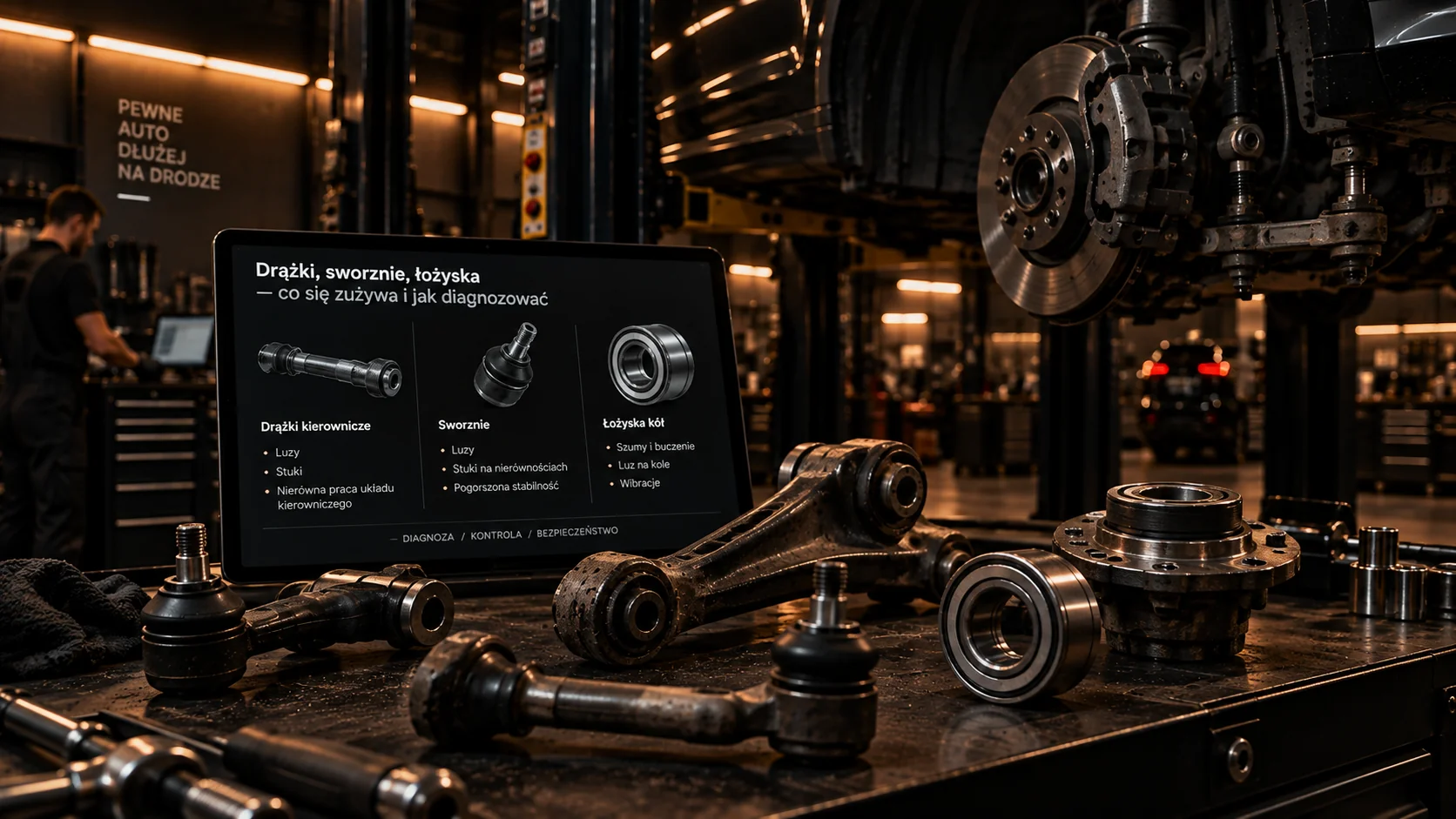





Tie rod ends, control arm ball joints, and wheel bearings are three different components that produce surprisingly similar symptoms — play, knocking over bumps, reduced stability — but wear out for different reasons and need different checking methods. From the driver's seat they're hard to tell apart, which is why at the workshop they're checked on a lifted car, separately for each component. In this guide we show exactly what each of these parts does, how it wears, and the method a mechanic uses to determine which one actually needs replacing.
Tie Rod Ends — What They Do and How They Wear
Tie rods (specifically their outer ends) connect the steering system to the wheels, translating the steering wheel's movement into the wheels turning. Each end has a ball joint covered by a dust boot, which needs to move smoothly but without play for the steering to respond precisely.
- Play in the steering — the wheel responds with a delay, or the car seems to "wander" on a straight road.
- Knocking when turning, especially in a parking lot at low speed, when the joint is under the most load.
- Uneven tire wear at the edges of the tread — a loose tie rod changes the wheel's tracking geometry.
- A damaged or cracked dust boot — even with no symptoms while driving, this signals that dirt and moisture are getting into the joint and speeding up its wear.
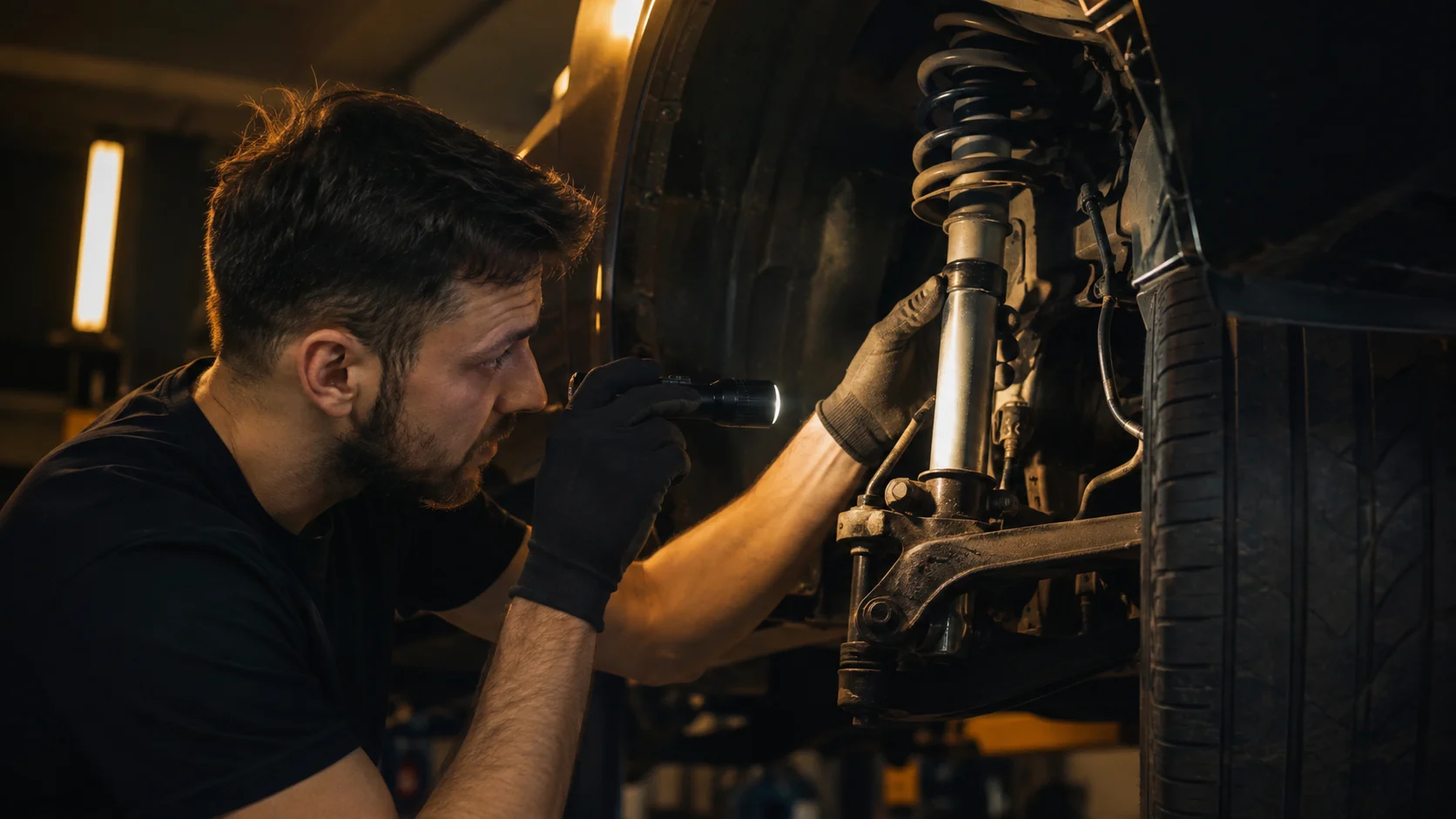
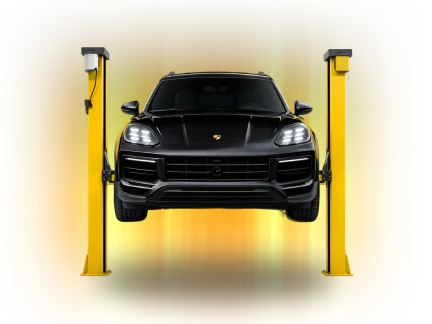
The diagnostic is simple: with the car lifted, the mechanic grips the tire at the front and back, then moves it along the transverse axis (as if trying to "stretch" it sideways) while watching the tie rod end. A noticeable, uncontrolled movement in the joint means play that calls for replacement.
Control Arm Ball Joints — What They Do and How They Wear
The ball joint connects the suspension's control arm to the steering knuckle, letting the wheel move up and down and turn, while transferring road loads. It's a heavily loaded mechanical part — it works with every suspension movement, not just when turning the wheel.
- Play detected with a pry-bar test — the mechanic lifts the wheel with a pry bar or lever under the control arm and checks for vertical movement in the joint.
- A dull knock over bumps, more pronounced than with worn bushings, since the ball joint directly carries vertical loads.
- Reduced stability in corners — a loose ball joint lets the wheel move uncontrollably under side load.
- A torn ball joint boot — just like with tie rods, a damaged boot speeds up corrosion and wear even before other symptoms show up.
A Worn Ball Joint Is Not Something to Delay
In an extreme case, a badly worn ball joint can pull apart entirely, leading to a sudden loss of control over the wheel. It's one of the few suspension components where even moderate play found during an inspection is reason enough not to put off replacement.
Wheel Bearings — What They Do and How They Wear
A wheel bearing lets the wheel rotate freely with minimal friction while carrying the car's weight on the hub. Unlike tie rods and ball joints, a worn bearing is usually audible before it's felt in the handling.
- A hum or drone that grows with speed — the most characteristic symptom, often mistaken for tire noise.
- Sound that changes intensity when turning — turning one way unloads the bearing on one side of the car and loads it on the other, changing the volume of the noise.
- Noticeable play when gripping the wheel at the 12 and 6 o'clock positions — the mechanic checks this on a lifted car by moving the wheel vertically, not side to side.
- Vibration transmitted to the body at higher speeds, increasing as wear progresses.
An additional test is spinning the lifted wheel freely — uneven resistance, binding, or a noticeable grinding feel during rotation points to damaged races or balls inside the bearing.
What Accelerates Wear on These Parts
Tie rods, ball joints, and bearings wear naturally with mileage, but a few factors can shorten their lifespan far more than mileage alone.
- Hitting curbs and potholes — a sudden, heavy load can damage a joint even on a car with low overall mileage.
- Damaged dust boots — a cracked boot lets dirt, water, and road salt into the joint, which wears many times faster without lubricant and protection.
- Driving on salted roads in winter — corrosion attacks the metal parts of joints and bearings from the outside, regardless of how carefully you drive.
- Overloading the car — regularly driving with heavy loads (roof box, trailer, a full car of passengers) pushes stress on bearings and ball joints above normal levels.
What Happens If You Ignore It
A worn tie rod, ball joint, or bearing rarely stays an isolated problem. Play in one component changes how the wheel behaves relative to the body, which accelerates wear on nearby parts — tires, other joints, and sometimes even the alignment, which eventually stops holding its settings. The longer a car drives around with detected but ignored play, the more components can end up affected, and the repair grows from one part to several.
Why These Three Components Are Checked Together
Tie rods, ball joints, and bearings sit physically close together and produce overlapping symptoms — a knock over a bump could come from any of them, sometimes from two at once. That's why a proper diagnosis isn't about guessing from the sound in the driver's seat, but about checking each component separately on a lifted car. If you're wondering how to identify the specific type of knock before your workshop visit, we covered that in why the suspension knocks over bumps.
- Tie rod ends — symptoms mainly when turning the wheel, checked with transverse wheel movement.
- Control arm ball joints — symptoms mainly over bumps and in corners, checked with a pry-bar test under the control arm.
- Wheel bearings — symptom audible regardless of steering, growing with speed, checked with vertical wheel movement and free rotation.
It's also worth remembering that these aren't the only source of suspension play — bushings wear for different reasons and follow a different inspection schedule, which we covered in when to replace bushings.
A Good Time to Check: Your Seasonal Tire Swap
The car is already up on the lift during the winter/summer tire swap anyway, so it's a natural moment to ask for a check of the tie rods, ball joints, and bearings — without booking a separate visit just for that.
How does a mechanic check tie rod ends?
With the car lifted, they grip the tire at the front and back and move it along the transverse axis while watching the tie rod end — noticeable play in the joint means replacement is needed.
Is a worn ball joint dangerous?
Yes, more so than other suspension components — in an extreme case, a badly worn ball joint can pull apart entirely, causing a sudden loss of control over the wheel. It's not worth delaying replacement once play is detected.
How do you recognize a worn wheel bearing?
The most characteristic symptom is a hum or drone that grows with speed, often changing intensity when turning. The mechanic also checks for wheel play and free rotation on the lift.
Does a knock over bumps always come from one specific part?
Not necessarily — tie rods, ball joints, and bearings sit close together and produce overlapping symptoms, and sometimes two components fail at once. That's why they're checked separately on a lift instead of guessing from the sound.
Can I check these parts myself at home?
Without a lift it's hard to do safely and accurately — the tests require raising the wheel and manually checking for play in a specific direction. It's simplest to do this during another visit, like a seasonal tire swap.

Let's Check Your Tie Rods, Ball Joints, and Bearings on the Lift
A separate check for each component — no guessing from the sound, with a clear answer on what actually needs replacing.