







The simplest self-test for a shock absorber is the bounce test: press down hard on the corner of the bumper or bodywork above the wheel, let go, and count how many times the car keeps bouncing — a healthy shock absorber settles the motion after one, at most two bounces. If the car keeps rocking longer than that, it's a sign the shock isn't damping vibration the way it should. Below we walk through that test step by step, an additional visual check for oil leaks, and symptoms that are easy to notice during normal driving — and at the end we explain when none of these tests can substitute for a check on a lift.
The Bounce Test — Step by Step
This is the fastest test you can do without any tools, taking a few minutes at each corner of the car:
- Park on a flat surface and go to one of the car's corners — it's best to start at a front wheel.
- Push down hard on the bodywork above the wheel (the bumper or fender) with your full body weight, a few times, to get the car moving.
- Let go suddenly and watch how the body behaves.
- Count the bounces — a healthy shock lets the body settle back to rest after one, at most two movements. More bounces than that means the shock isn't damping energy well.
- Repeat at every corner of the car — shocks usually wear unevenly, so the result can differ from wheel to wheel.
A Difference Between Wheels Is Also a Signal
Even if the result at each wheel seems "within normal range," a clear difference in the number of bounces between the left and right side of the car is a warning sign on its own — the suspension should behave symmetrically.
Visual Check — Oil Leaking from the Shock Absorber
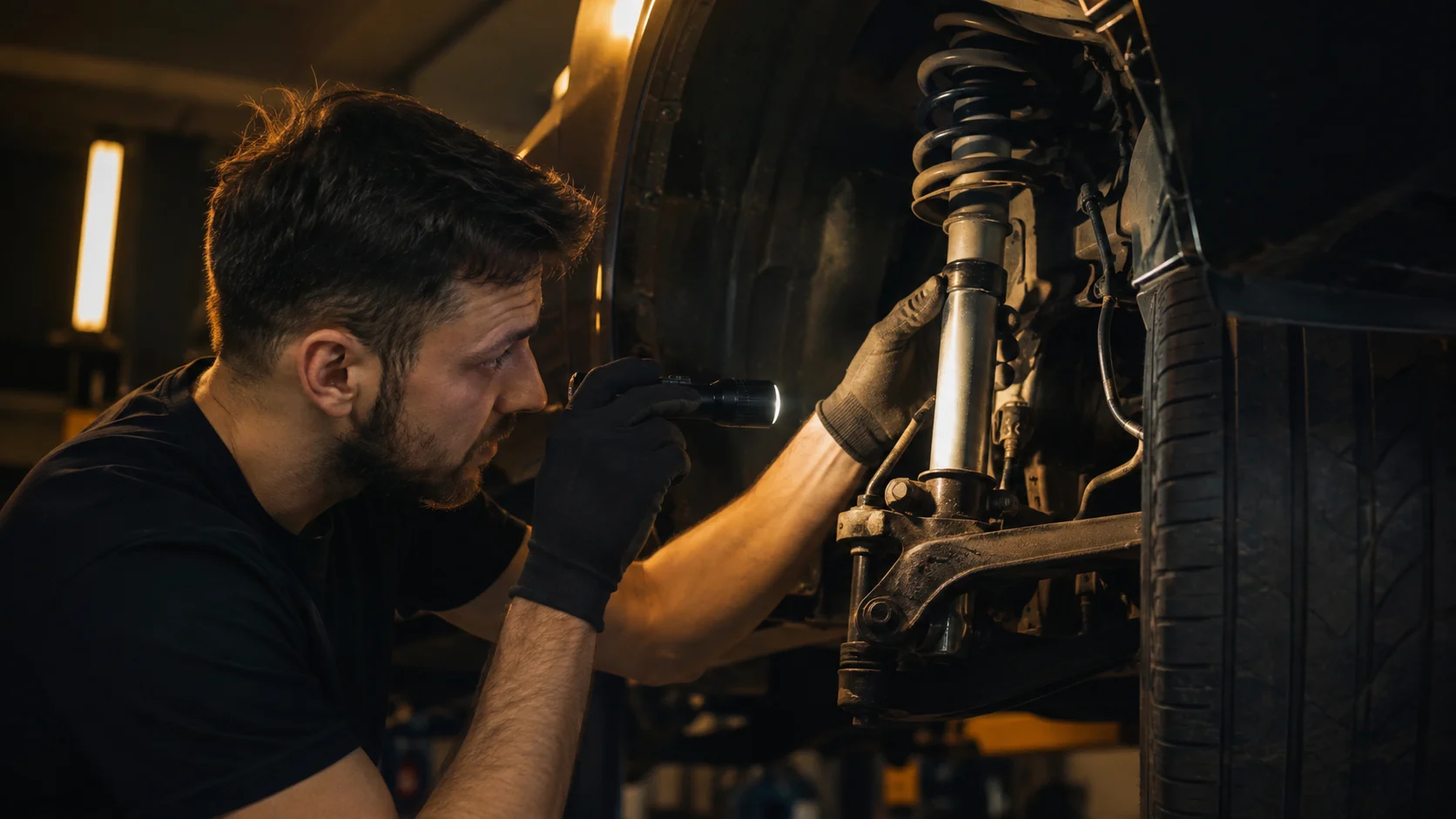
A hydraulic shock absorber damps vibration using oil sealed inside a cylinder. When the seal wears out, oil starts leaking to the outside — and that's visible without any tools, you just need to bend down and take a look.
- A damp or oily film on the shock absorber body, especially near the bottom — this is the clearest sign of a leak.
- Grime mixed with oil on the housing — dust and dirt stick easily to an oily surface, so it's worth wiping the shock down with a rag and checking again after a few days of driving.
- Visible streaks on the rim or the inner side of the wheel coming from above — can point to a leak from a shock absorber mounted higher up in the wheel well.
An Oil Leak Means the Shock Needs Replacing
Unlike the bounce test, which can sometimes give an ambiguous result, a visible oil leak is unambiguous — a damaged shock absorber can't be repaired, only replaced with a new one.
Symptoms You'll Notice While Driving
Worn shocks make themselves felt even before you decide to run any tests under the car. A few everyday driving situations are worth paying attention to.
- Nose-diving under braking — the front of the car visibly dips during harder braking, and for longer than it used to.
- Body roll in corners — the car leans more to the sides than it used to, even at moderate speed.
- "Floating" over bumps — the body keeps rocking for a while after a speed bump or pothole, instead of settling quickly.
- Uneven tire wear — if the tread wears in patches or faster on one side, weak shocks are often the cause, not just alignment.
When the Test Alone Isn't Enough
The bounce test and visual check catch serious cases well, but they can't replace an inspection on a lift. A shock absorber can be in the early stages of wear — with no visible leak and a test result that still looks "fine" — and yet already damp vibration worse on rough roads at higher speed than a new one would. A full diagnosis needs a look from underneath: checking the upper and lower mounts, bushings, ball joints, and the condition of the shock itself up close.
If you have access to the lift in the Self-Service Zone, you can do this inspection yourself — up close you'll see things you can't spot standing next to the car. If you'd rather have someone else assess it, we covered the symptoms of worn suspension in more depth in symptoms of worn suspension — when to go to a mechanic, and if you're also hearing knocking over bumps, that's a different topic altogether — check out why the suspension knocks over bumps.
How many bounces is normal in the bounce test?
A healthy shock absorber settles the motion after one, at most two bounces. Three or more bounces mean the shock is damping energy poorly and is worth checking more closely.
Does an oil leak from a shock absorber always mean it needs replacing?
Yes — a hydraulic shock absorber runs on a sealed oil circuit. Once the seal starts leaking, it can't be repaired, only the whole shock absorber replaced.
Can I check my shocks myself without a lift?
The bounce test and the visual leak check can both be done without a lift. A full inspection of the mounts, bushings, and ball joints already needs access from underneath — for example, at the Self-Service Zone.
Can uneven tire wear be caused by weak shock absorbers?
Yes, patchy or uneven tread wear can sometimes result from weak shock absorbers, not just alignment or balancing issues.
What if the test comes out differently on different wheels?
That's a warning sign in itself — the suspension should behave symmetrically, and a clear difference between sides indicates at least one shock absorber needs a closer look.

Check Your Shocks Up Close on a Lift
Rent a bay in the Self-Service Zone and inspect the suspension yourself — or book a check with us.