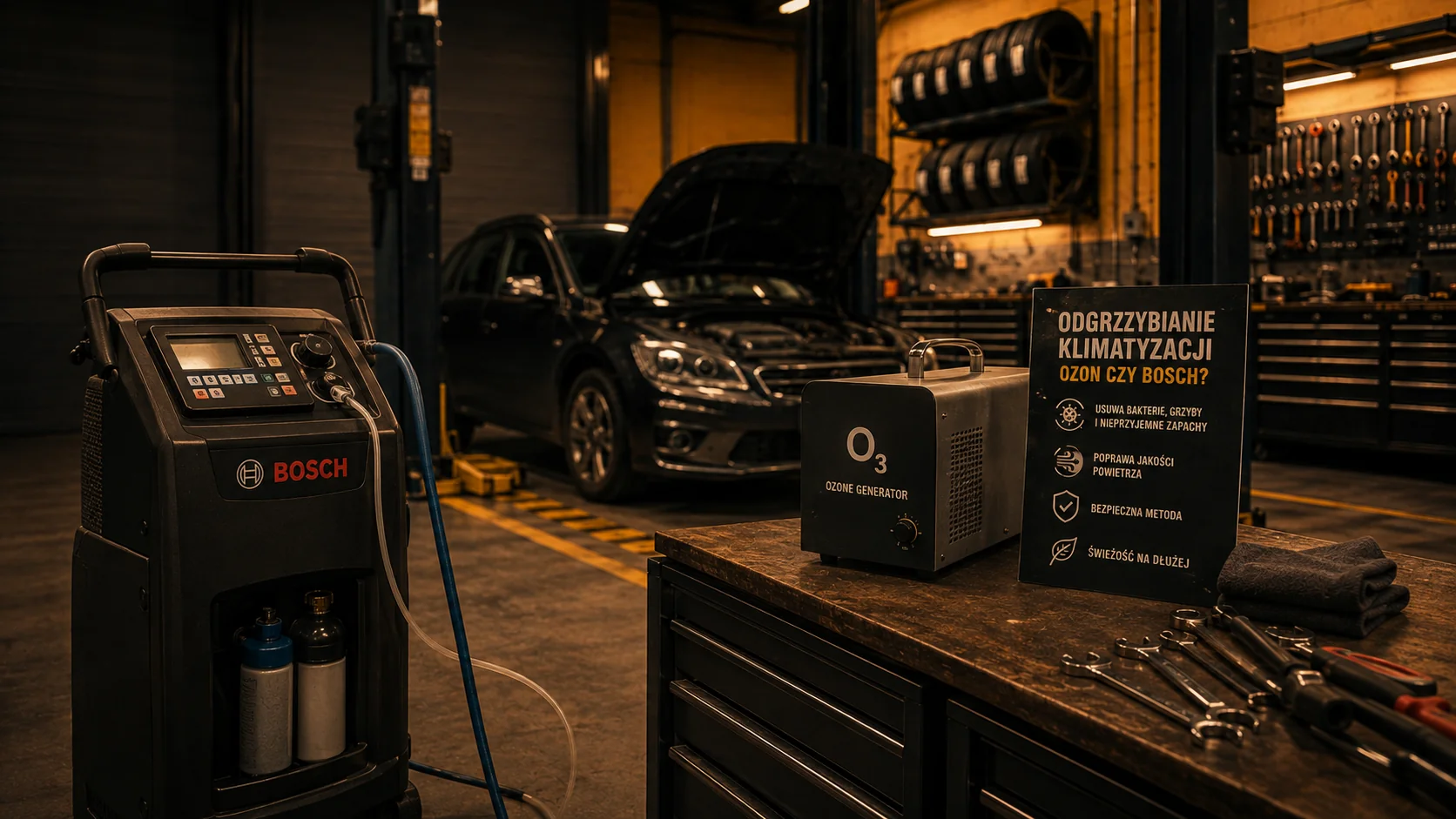





If your air conditioning smells bad, evaporator disinfection with a product applied directly into the system is more effective — the way we do it at our Bosch station — because it works exactly where the bacteria live. Ozone treatment is an excellent complement: it removes odour from upholstery, ducts and the whole cabin, but on its own it rarely solves the problem for good. In practice the best result comes from combining both methods together with a new cabin filter. In this article we explain where mould in an air conditioning system comes from, how each method actually works, what they cost, how long they take, how often to repeat them and what you can do yourself so the smell doesn't return within a month.
Where mould and the unpleasant smell in air conditioning come from
Air conditioning cools the air by passing it through the evaporator — a dense aluminium "radiator" hidden deep inside the dashboard. Air at 25–30 °C meets a surface chilled to a few degrees, so water vapour condenses on it instantly. It is the same mechanism that leaves a puddle under the car after driving with the AC on — and that is completely normal.
The problem starts when that moisture stays in the system after you park. A dark, warm, wet place coated with dust, pollen and exhaust particles is the ideal environment for bacteria, mould and fungi. Colonies grow on the evaporator fins and in the ventilation ducts, and once the blower starts, the air carries their spores and metabolic products straight into the cabin. Hence the characteristic musty "old cellar" smell that appears during the first dozen or so seconds after you switch the fan on.
- Smell right after switching the fan on — the most typical symptom, usually strongest after the car has stood for a while.
- Windows fogging up despite the AC being on — a wet, dirty evaporator dries the air less effectively.
- Weaker airflow — deposits and a clogged cabin filter restrict the flow of air.
- Sneezing, a runny nose, irritated eyes in the car — an allergic reaction to mould spores circulating in the cabin.
- Damp and odour all year round — not just in summer; the ventilation system runs in winter too.
The smell is a symptom, not the disease
An air freshener masks the problem for a few days but does not remove its cause. As long as biofilm remains on the evaporator, the smell always comes back — usually stronger than before.
Ozone treatment for air conditioning — how it works
Ozone (O₃) is a highly unstable form of oxygen and, at the same time, a powerful oxidiser. The ozone generator is placed in the cabin, the ventilation is set to recirculation and the car is closed for several dozen minutes. The ozone spreads with the air through the entire interior and the ventilation ducts, oxidising the cell walls of bacteria and fungi and breaking down the molecules responsible for the smell. After the treatment ozone decomposes back into ordinary oxygen on its own, so it leaves no chemical residue behind.
What ozone is genuinely good at
- The whole cabin, not just the air conditioning — upholstery, headliner, carpet, seat belts, boot.
- Odours soaked into materials — cigarette smoke, pets, spilled milk, a car flooded by high water.
- Hard-to-reach spots — as a gas, ozone reaches everywhere the air reaches.
- No dismantling — nothing has to be taken apart, the treatment is quick and non-invasive.
- Preparing a car for sale — the interior smells neutral, without a layer of air freshener on top.
The limits of ozone treatment
Ozone is a gas and it works on the surface. If a thick, greasy biofilm has built up on the evaporator fins, the gas will only oxidise its outer layer, while the layer underneath survives and rebuilds the colony within a few weeks. That is why the smell sometimes disappears for two or three weeks after ozone alone and then returns — leaving the owner with the impression that "ozone doesn't work". It does work; it was simply used for a job it cannot finish on its own.
Ozone in high concentrations is harmful
Ozone treatment is a job for a workshop, not a do-it-yourself experiment in a car park. Afterwards the car must be aired out thoroughly before anyone gets in. High ozone concentrations irritate the airways, and prolonged exposure accelerates the ageing of rubber seals and plastic parts.
Evaporator disinfection at a Bosch station — how it looks
The second method works locally and mechanically. We apply a disinfecting foam or aerosol with a probe directly into the evaporator housing — through the condensate drain, through the cabin filter housing or through the air intake. The foam coats the fins, dissolves greasy deposits and biofilm, and then drains out under the car through the drain hose along with the dirt. This is exactly the part of the system where the problem lives.
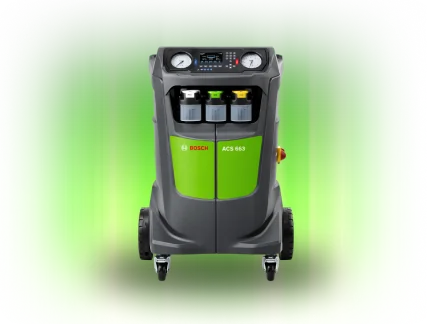
We do this at our Bosch air conditioning service station at Grabiszyńska 241, usually as part of a larger visit. The disinfection itself takes about 30–45 minutes, and if we combine it with a refrigerant service the car stays with us for 1–1.5 hours.
A standard system disinfection at our workshop goes like this:
- Assessing the system — we check the cabin filter, the condensate drain and the strength of the airflow; that alone shows how neglected the system is.
- Replacing the cabin filter — without it the whole treatment is pointless, because the old filter is the second home of the mould.
- Applying the product to the evaporator — with a probe, with the ventilation running, so the foam spreads across the entire surface.
- Dwell time and draining the dirt — the product dissolves the biofilm and flows out through the condensate drain.
- Blowing through the ducts — we dry the system and clear any residue out of the ventilation ducts.
- Checking the result — we verify the smell and the cooling performance; while we are at it we measure pressures and tightness if the AC cools poorly.
A clear condensate drain is half the battle
A blocked condensate drain hose leaves water standing in the evaporator housing. No disinfection lasts long under those conditions. We check that the drain is clear at every visit — a free step that can save you another treatment six months from now.
Ozone or Bosch — a direct comparison
The two methods solve slightly different problems, so asking "which is better" only makes sense for a specific car. Here are the key differences.
- Coverage — ozone reaches the whole cabin and every material; the Bosch product works locally on the evaporator and in the ducts.
- Effectiveness against thick biofilm — disinfection with a product wins clearly here, because it dissolves the deposit rather than only oxidising it.
- Effectiveness against odours from upholstery — ozone wins here, because a product on the evaporator does nothing about smoke soaked into the headliner.
- Time — ozone treatment usually takes 30–60 minutes plus airing out; evaporator disinfection takes 30–45 minutes.
- How long the effect lasts — disinfection with a new filter usually lasts a season or two; ozone alone on a neglected evaporator often only a few weeks.
- Cost — roughly 80–150 zł for disinfection with either method; a full air conditioning service with disinfection is usually 250–500 zł.
Our recommendation in short
A smell from the vents and nothing more — evaporator disinfection plus a new cabin filter. A car from a previous owner, a smoker, a pet or after flooding — evaporator disinfection first, then ozone treatment of the whole cabin. Ozone on its own makes sense when the air conditioning has already been serviced and the smell comes from the interior materials.
The cabin filter — the part without which nothing works
The cabin filter traps dust, pollen and soot before they reach the evaporator. After a year of service it is simply a dirty, damp mat full of organic matter — a second home for mould, right at the air inlet to the cabin. Disinfecting without replacing it is like mopping the floor with a dirty rag: the effect is gone within a week.
The filter is replaced once a year or every 15,000 km, and more often if you drive mostly in the city. Wrocław conditions — traffic on Grabiszyńska, Legnicka and the ring road — mean a lot of brake dust and exhaust fumes, so the filter clogs faster than in long-distance driving. It is worth paying extra for the activated carbon version: besides pollen it also traps some odours and volatile compounds.
This, incidentally, is one of those jobs you can easily do yourself — in most cars the filter sits behind the glovebox and takes a few minutes to change without lifting the car. If you like doing this kind of work yourself, our Self-Service Zone with a lift and tools is at your disposal.
How often to disinfect your air conditioning
For a car used daily under normal conditions, once every one to two years is a sensible rhythm — ideally in spring, before the season, together with a refrigerant check. While we are at it we check the refrigerant loss, which naturally runs at about 10–15% a year, so the two jobs complement each other nicely. We write more about recharging itself and when it is needed in our article on when to recharge your air conditioning.
- Once every 2 years — a garaged car, mostly long-distance driving, filter replaced regularly.
- Once a year — normal city driving, car parked outside, including under trees.
- Twice a year — allergy sufferers, families with small children, vans and taxis, cars that have been flooded.
- Immediately — when the smell is clear, the windows fog up despite the AC, or you can see traces of damp on the carpet.
What you can do yourself to keep the mould away
The most effective habit costs nothing: switch the air conditioning off (the A/C button) 3–5 minutes before the end of your drive, leaving the blower running. The evaporator then has time to warm up and dry out, and you park the car with a dry system instead of a wet one. This single change can extend the effect of a disinfection by well over a year.
- Don't drive permanently on recirculation — moisture from the cabin then goes round in circles and settles on the evaporator.
- Use the air conditioning in winter too — running the system regularly lubricates the compressor and dries the air, reducing window fogging.
- Check whether a puddle appears under the car after parking — its absence with heavily used AC can mean a blocked condensate drain.
- Replace the cabin filter once a year — the cheapest preventive measure in the whole system.
- Don't leave the car parked for long with wet mats — moisture from the interior gets into the ventilation system the moment you switch the fan on.
What it costs and how to book a visit in Wrocław
Disinfection alone — whether with ozone or with a product — costs roughly 80–150 zł. On top of that comes the cabin filter, usually 50–120 zł for the part depending on the model and whether you choose the activated carbon version. If the AC also cools poorly, it makes more sense to do a full service with a refrigerant recharge and disinfection in one visit — that is usually 250–500 zł, depending on the type of refrigerant. We have collected detailed price ranges in our article on air conditioning service prices in Wrocław.
We work at Grabiszyńska 241 at a Bosch station with F-gas certification, so refrigerant is recovered and topped up in line with the regulations, not by guesswork. You can book a slot online in a few minutes — you pick the service and the time, and we will fine-tune the scope on site after inspecting the system.

Book air conditioning disinfection in Wrocław
Evaporator disinfection, cabin ozone treatment and a new filter — at our Bosch station at Grabiszyńska 241. Check available slots online.
Which is more effective — ozone or disinfection with a product?
When the smell comes from the air conditioning, evaporator disinfection with a product is more effective, because it dissolves the biofilm where it forms. Ozone deals better with odours soaked into upholstery and the headliner. The longest-lasting result comes from combining both methods with a new cabin filter.
How long does air conditioning disinfection take?
Evaporator disinfection takes about 30–45 minutes, ozone treatment 30–60 minutes plus time to air the car out. If we combine the treatment with a refrigerant service, the car normally stays in the workshop for 1–1.5 hours.
Is ozone treatment safe for the car interior?
Done properly — yes. What matters is the right concentration, the right treatment time and airing the car out thoroughly before driving. Prolonged exposure to high ozone concentrations accelerates the ageing of rubber seals and plastic parts, which is why we don't recommend treatments with a "home" generator without any control over the timing.
Why did the smell come back a month after the disinfection?
The most common causes are a cabin filter that was not replaced, a blocked condensate drain, or the use of ozone alone against a thick biofilm on the evaporator. In that case you need disinfection with a product applied directly to the evaporator and a check that the drain is clear.
Does disinfection have to be done together with an AC recharge?
It doesn't have to be, but it is more convenient and cheaper than two separate visits. Refrigerant loss naturally runs at about 10–15% a year, so checking the charge and disinfecting complement each other perfectly — ideally in spring, before the season.