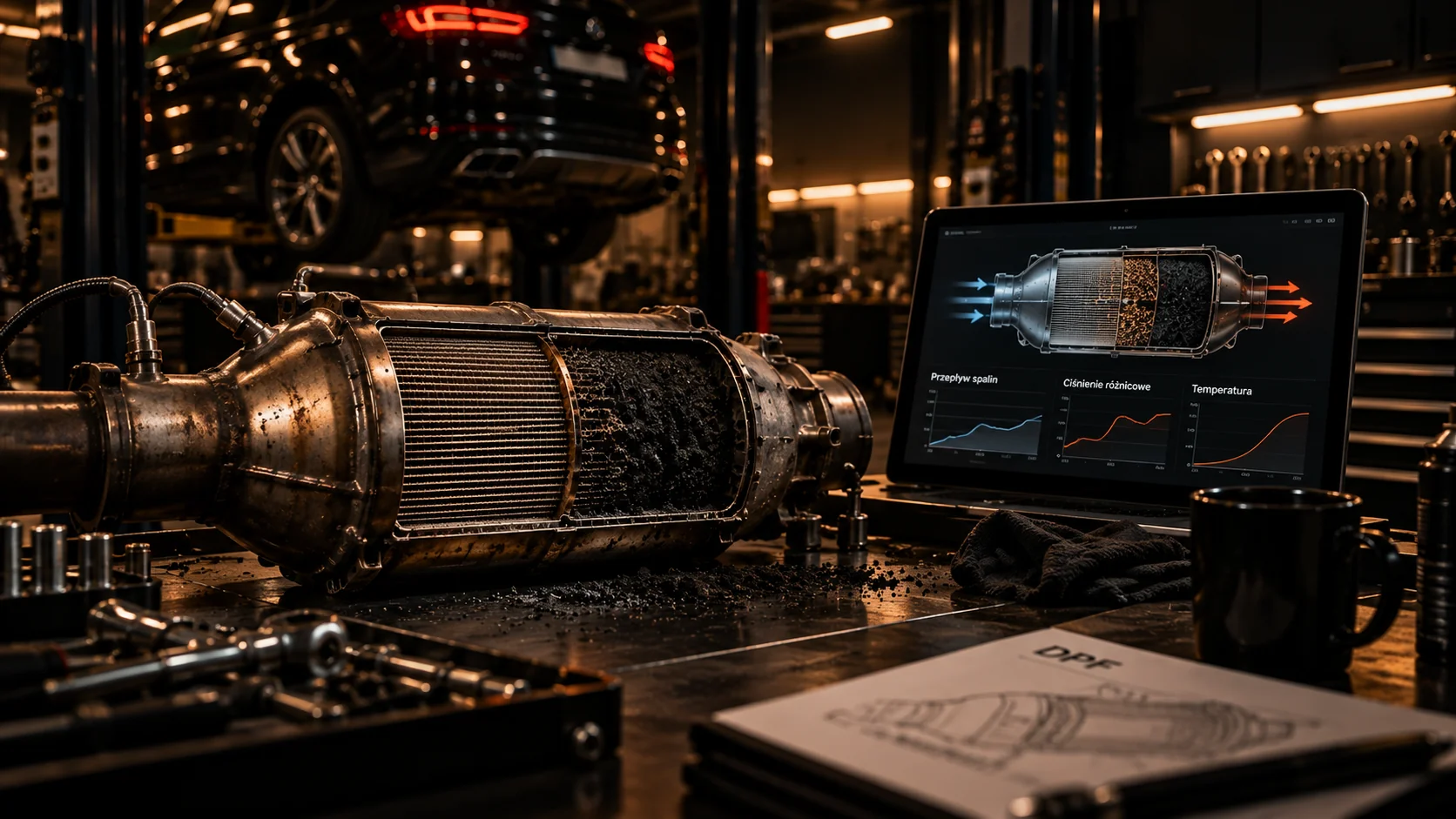






A clogged DPF usually gives itself away before the warning light comes on — through a loss of power when accelerating, higher fuel consumption, a louder-running engine and a distinctive, sharper exhaust smell. The earlier you catch these signs, the better the odds that plain regeneration is enough instead of a costly hydrodynamic wash or filter replacement. Below are eight signs worth knowing and a short guide to what to do once you notice them.
1. A noticeable loss of engine power
This is usually the first thing drivers notice — the car doesn't „pull” the way it used to, especially under hard acceleration or load (climbing a hill, overtaking). A clogged filter builds up more and more resistance to the exhaust flow, and the ECU limits power to protect the system from excess back-pressure.
2. Higher fuel consumption
An engine running with a clogged filter has to work harder to push exhaust through, and on top of that the ECU keeps trying to trigger regeneration, injecting extra fuel each time. The result: the same car, the same route, and noticeably more litres on the clock than usual.
3. A louder, rougher-running engine
A change in how the engine runs at idle — an uneven idle, more noticeable vibration, an overall „rougher” feel — is often a result of disrupted exhaust flow and more frequent regeneration attempts. It's worth linking this sign to others on the list, since on its own it can have many causes.
4. A distinctive exhaust smell
During regeneration (active or forced) the exhaust gets a sharper, more „chemical” smell — that's normal for a single cycle. It becomes a warning sign when this smell shows up unusually often or lingers a long time after the engine is switched off.
5. Visible, thick smoke from the exhaust pipe
A healthy DPF is meant to trap almost all soot — if clearly visible, dark smoke is coming out of the exhaust pipe, it's a sign the filter is no longer doing its job, or has been damaged. This is one of those signs not worth ignoring even for a few days.
6. A longer, more frequent idle after switching off
If, after reaching your destination, the engine keeps running at raised revs for a moment instead of settling straight to idle, that's usually a sign a regeneration cycle is running in the background and didn't finish on the road. On its own it's harmless, but if it happens on almost every trip, it signals the car never gets the chance for passive regeneration.
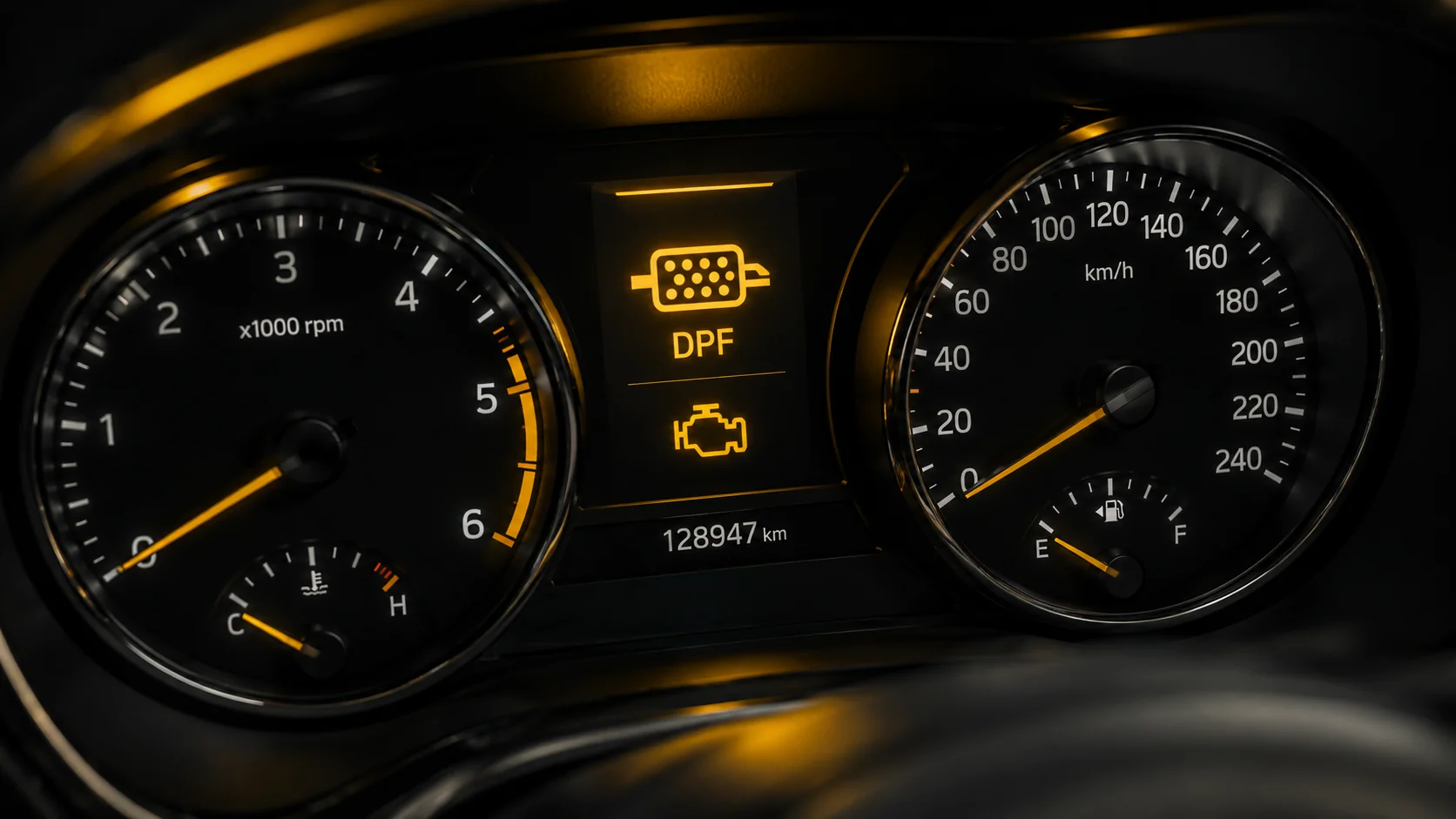
7. The DPF or check-engine light on the dashboard
This is already an unambiguous signal, though it usually shows up last on this list, after the other signs were already present. We covered the full range of warning lights and what their colours mean in a separate article: dashboard warning lights — what the colours mean and when to visit a workshop.
A flashing DPF light means don't wait
A steady light usually means the car is asking for regeneration or a check-up. A flashing light, or one paired with a noticeable loss of power, signals a more serious problem — it's worth cutting driving down to the essential minimum and booking diagnostics as soon as possible.
8. Trouble starting the engine, or it feels like it's „struggling”
With a heavily clogged filter, the engine can struggle to reach starting revs, because back-pressure hampers free exhaust flow from the very first seconds of running. This sign tends to show up last and comes alongside an already-obvious loss of power on the road.
What to do once you notice these signs
Don't wait for the warning light to come on for good. The earlier you catch the problem, the better the chance that diagnostics plus a filter burn-off will do, instead of a more expensive hydrodynamic wash or replacement. We covered the regeneration mechanism — passive, active and forced — and when each one is enough, in a separate article: burning off a diesel particulate filter — how DPF regeneration works.
- Note down when and how often you notice the signs — it makes diagnostics easier.
- Don't ignore the DPF or check-engine light — continuing to drive with an active problem usually makes it worse.
- Book diagnostics before trying anything yourself — we'll check the sensors, EGR and the filter's condition to pick the right fix.
- Don't reach for DPF removal as a „quick fix” — it's illegal and in practice doesn't solve the underlying problem, see: removing the DPF — is it worth it.
Diagnostics is the best-spent first 100–200 PLN
Before we suggest burn-off, washing or replacement, we check the sensors, the EGR system and the filter's actual condition — a clogged DPF is often the result of another fault, not the root cause itself. The diagnostic fee is usually deducted from the regeneration price.
You'll find the full price list and cleaning process in the article DPF cleaning and regeneration — price, process, how long it takes, and service details on the DPF/FAP cleaning and regeneration page.

Noticed one of these signs?
Book DPF diagnostics in Wrocław. We'll find the cause before the repair gets more expensive.
What's the first sign of a clogging DPF?
Most often it's a noticeable loss of engine power when accelerating, especially under load, along with higher fuel consumption — before any warning light comes on at all.
Can I keep driving once I notice signs of a clogged DPF?
Briefly — yes, but it's not worth putting off diagnostics. The longer a car drives with a clogging filter, the higher the risk that the soot hardens into a tougher form, or the filter gets damaged, which raises the cost of the repair.
Does a louder-running engine always mean a DPF problem?
Not always — it can have other causes. But combined with a loss of power, higher fuel use or an exhaust smell, it's worth treating as a signal to check the filter.
How much does DPF diagnostics cost?
Roughly 100–200 PLN, usually deducted from the regeneration price if one turns out to be needed. Diagnostics shows whether the issue is simple soot clogging or a sensor or EGR fault.
Does smoke from the exhaust always mean a clogged DPF?
Visible, dark smoke more often points to the filter no longer trapping soot effectively — that can be down to a damaged core, not just clogging. Either way, it's worth checking as soon as possible.
What happens if I ignore these signs?
The problem usually gets worse — from a regeneration that would still have been enough, through the need for a hydrodynamic wash, to replacing the filter entirely if it suffers mechanical damage. An early reaction is the cheapest option.